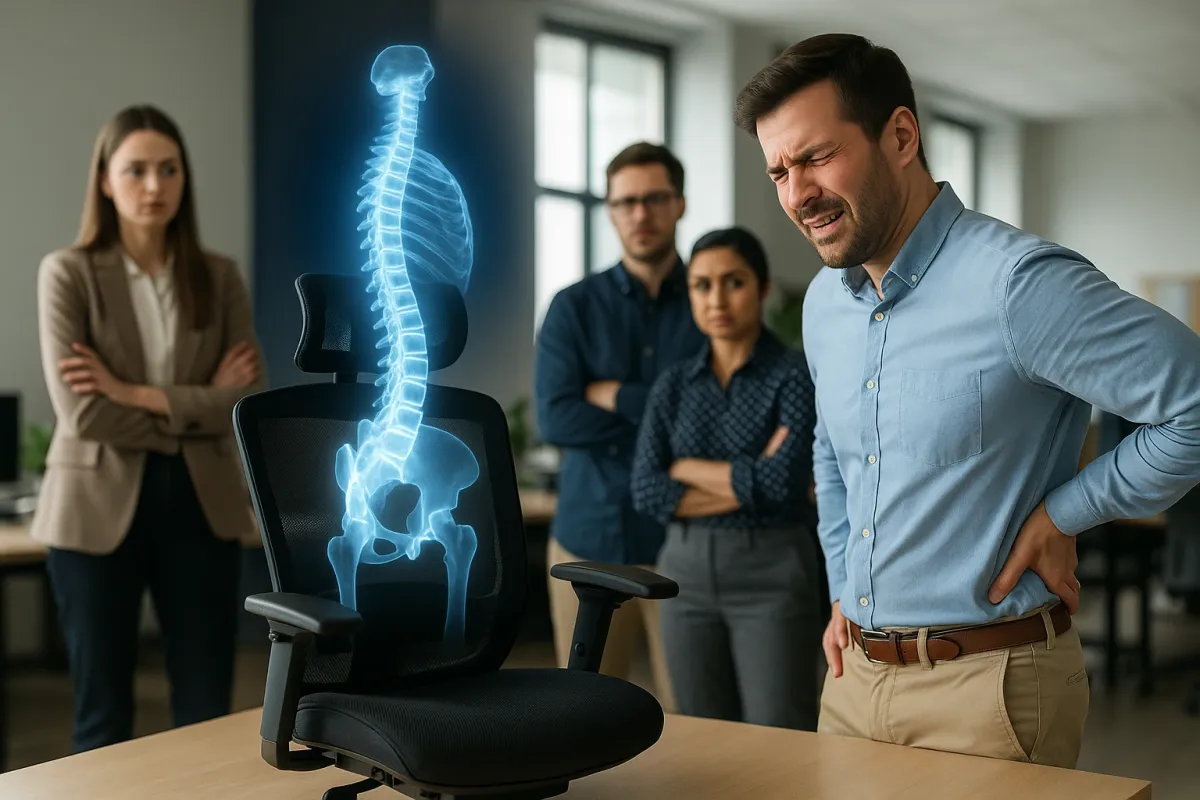
In a week when the internet is captivated by a man calling the police over a coworker repeatedly stealing his $1,800 Herman Miller Aeron chair, one detail cuts through the drama: people are willing to involve law enforcement over a seat. Beneath the outrage and office politics lies a deeper truth—our chairs have become proxies for our pain, our productivity, and, increasingly, our health.
As the story of the “arrest over an Aeron” ricochets across social media, it reveals a cultural moment where ergonomic furniture is no longer a luxury eccentricity but a line of defense against chronic spinal strain. If a single chair can be worth $1,800—and a visit from the police—what does that say about the real cost of unmanaged back pain in modern work life?
Below, we distill this viral headline into five refined, forward-thinking insights for those navigating back pain in a world where your seating is suddenly front-page material.
1. When Ergonomics Becomes Evidence: Why Your Chair Choice Now Signals Serious Pain
The viral case of the high-end Herman Miller Aeron being “borrowed” in a corporate office—and ultimately leading to an on-the-spot arrest—highlights something unmistakable: people are no longer treating ergonomic seating as optional office décor. They are treating it as medically relevant equipment. In clinical pain management, high-quality seating is now routinely recommended as part of a conservative care plan for chronic low back pain, especially for desk-based professionals spending 6–10 hours seated daily.
The Aeron, Steelcase Leap, and other premium chairs are designed around pressure distribution, lumbar support, and micro-adjustability—features that help reduce sustained spinal load. When someone relies on that chair to manage disc strain, facet joint irritation, or post-surgical sensitivity, it stops being “just a chair” and becomes a therapeutic tool. The outrage in the viral story isn’t purely about property; it’s about the casual violation of someone’s pain management strategy. If you live with back pain, treating your chair as clinical infrastructure—not a casual accessory—is not indulgent; it is rational, protective, and increasingly, culturally validated.
2. Pain Is Invisible—but Your Environment Doesn’t Have to Be
One reason the $1.8K chair saga struck such a nerve is that back pain is often invisible. A coworker sees an empty ergonomic throne and thinks “nice upgrade,” not “essential medical support.” This disconnect echoes a broader societal challenge: musculoskeletal pain rarely announces itself with a cast, bandage, or visible brace. It is experienced internally, but modulated externally—through the way you sit, move, and arrange your surroundings.
Sophisticated pain management in 2025 is about making your environment do more of the work. Height-adjustable desks, monitor arms, carefully calibrated chair settings, and footrests act as external scaffolding for an irritated spine. The more strategic your environment, the less your back has to compensate. The lesson from the viral office dispute is simple: if your environment is part of your treatment, it deserves clear boundaries and, occasionally, unapologetic protection. Label your chair, document your ergonomic setup if necessary, and do not hesitate to calmly assert that these are part of your health regimen, not negotiable perks.
3. The New Pain Protocol: Micro-Adjustments Instead of Heroic Endurance
The Aeron incident also spotlights a broader shift: from a culture that glorifies “pushing through” discomfort to one that prizes micro-adjustments and early intervention. Historically, pain management in busy professionals often meant ibuprofen in the desk drawer and perseverance at any cost. Today, as work-from-home setups and hybrid offices proliferate, we are seeing a refinement in pain strategies—less about stoicism, more about precision.
For those with back issues, this means moving away from dramatic, infrequent fixes and toward small, frequent course corrections. Adjusting lumbar depth mid-day, raising your chair a centimeter to soften hip flexion, tilting the seat pan slightly forward, or alternating between sitting and standing every 30–45 minutes can dramatically reduce cumulative strain. High-end chairs are built for this exact dance—subtle, ongoing modifications that keep pain from crossing the line from manageable to flaring. The man defending his Aeron isn’t just defending a purchase; he is defending his right to finely tuned, responsive pain management.
4. Ownership, Boundaries, and the Psychology of Relief
The viral story also resonates because it touches a deeper nerve: the psychological dimension of pain and control. When someone repeatedly takes your customized chair, they are not merely borrowing equipment; they are destabilizing a carefully constructed sense of safety. For individuals living with persistent back pain, predictability and control are powerful analgesics. Knowing that your chair, desk height, and workstation will feel the same each day can calm the nervous system and reduce pain amplification.
Modern pain science emphasizes that our perception of safety, respect, and agency can modulate pain intensity. A workplace that trivializes your set-up—or treats your medical accommodations as optional—can inadvertently up-regulate stress and pain. Conversely, a culture that honors ergonomic boundaries and respects medical needs can facilitate genuine relief. The lesson here is exquisitely practical: document your needs, involve HR or occupational health if appropriate, and frame your ergonomic choices as clinically informed necessities, not personal whims. Your spine—and your nervous system—benefit when your boundaries are clear and upheld.
5. From Viral Spectacle to Personal Strategy: Curating a High-End Pain Management Ecosystem
The headline about a luxury office chair and a police report makes for entertaining reading, but for anyone living with back pain, it also offers a quiet invitation: to curate your own elevated, coherent pain management ecosystem. In a world where one high-end chair can attract nationwide attention, consider the full portfolio of supports at your disposal.
This ecosystem can include an ergonomically sophisticated chair, yes—but also a thoughtfully chosen mattress, a supportive car seat setup, targeted strengthening or mobility work prescribed by a clinician, judicious use of medications when necessary, and evidence-based modalities such as manual therapy or cognitive functional approaches. The true luxury is not a single expensive object; it is the orchestration of multiple refined elements that collectively reduce your pain burden and expand your freedom. Let the Aeron saga serve as permission, not merely entertainment: permission to take your environment seriously, invest strategically, and defend the tools that keep your spine functional in a demanding world.
Conclusion
The viral arrest over an $1.8K office chair may read like a workplace comedy, but beneath the spectacle lies a telling reality: we are entering an era where the line between “furniture” and “therapy” is rapidly dissolving. For those living with back pain, that evolution is overdue. Your chair, your desk, your physical space—these are not background details; they are active participants in your pain story.
Treat them accordingly. Curate them deliberately. Protect them unapologetically. Because in a world where an office chair can become evidence, your comfort is no longer incidental—it is central.
Key Takeaway
The most important thing to remember from this article is that this information can change how you think about Pain Management.