In a week when a new hire’s $1,800 Herman Miller Aeron chair became the center of an office drama—vanishing from his cubicle, reappearing under a colleague, and ultimately leading to an on‑the‑spot arrest—the internet focused on the spectacle: entitlement, workplace etiquette, and the shock factor of calling the police over a chair. Yet quietly embedded in this viral story is a more consequential truth: for anyone with back issues, your chair isn’t a “perk.” It’s medical equipment, injury prevention, and daily pain management rolled into one.
At Back Care Insights, we see this moment as more than a meme. It’s a timely reminder that premium ergonomic seating is no longer a niche luxury for design-obsessed tech campuses—it’s a frontline defense against chronic spinal stress. As high-performance chairs like the Aeron, Embody, Steelcase Leap, and similar models trend across remote and hybrid workplaces, the question is no longer “Is an $1,800 chair ridiculous?” but rather “What is the real cost of not protecting your spine?”
Below, we distill five exclusive insights for those who live with back issues—or are determined not to join that growing statistic—that go far beyond “sit up straight.” This is the ergonomics beneath the headlines.
1. Your Chair Is a Medical Asset, Not Office Décor
The viral Aeron incident underscores a subtle but crucial shift: the best office chairs are no longer mere furniture—they are interventions. When someone invests personally in a high-end task chair and brings it into a shared office, they are often compensating for disc degeneration, chronic low back pain, prior injury, or postural syndromes that a standard chair simply cannot accommodate.
For those living with disc disease, spinal stenosis, or persistent muscular tension, a well-designed chair functions like a custom orthotic for your spine. Adjustable lumbar support can reduce pressure on irritated nerve roots; a properly tuned seat pan can offload the sacrum and diminish the demand on spinal stabilizers. In this context, lending or commandeering someone’s chair is closer to borrowing their prescription eyewear than borrowing a pen. The lesson: if you rely on specific equipment to keep your back comfortable, treat it as personal medical infrastructure. Document the settings that work for you. If you must use shared seating, photograph and note ideal configurations, so your therapeutic setup is never purely at the mercy of office culture.
2. Premium Ergonomics Without Premium Chaos: Setting Boundaries at Work
The conflict that ended in an arrest over a chair reveals something uncomfortable about many workplaces: health-related needs are often considered negotiable, especially when invisible. Back pain doesn’t leave obvious marks; a premium chair looks like a luxury until you understand why it’s there. If you’re managing back issues, this disconnect matters.
Modern occupational health thinking increasingly recognizes ergonomic accommodations as essential, not indulgent. Many companies now have wellness budgets, ergonomic programs, or HR pathways for requesting specialized seating with documentation from a physician, physical therapist, or chiropractor. Yet too often, those with back conditions downplay their needs to avoid appearing “difficult.” The Aeron incident is an extreme example of what happens when personal health boundaries are never clearly articulated—frustration escalates until the situation becomes unmanageable.
An elegant approach is to normalize clear, calm communication early:
- Inform your manager and HR that your chair is part of a medically necessary setup for back support.
- Label the chair discreetly but unambiguously as personal equipment.
- If you work hybrid, ensure your home and office setups are both optimized, rather than relying solely on one premium location.
Respect for your seating is, in practice, respect for your spine. Establishing that connection explicitly can preempt conflict and protect your daily comfort.
3. The Hidden Cost of the “Free” Office Chair
In online reactions to the news story, one common refrain was: “Why not just use the office chair provided?” From a financial standpoint, that seems reasonable. From a spinal standpoint, it’s often costly.
Standard-issue office chairs are designed to satisfy budgets and broad averages, not specific spinal needs. For an individual with a history of lumbar strain or herniated discs, the “free” chair can be dramatically expensive in other currencies: missed workdays, flare-ups that sabotage sleep, increased reliance on pain medication, or a cascade of compensatory problems in the hips and neck.
High-performance chairs typically distinguish themselves in three ways highly relevant to back health:
- Precision adjustability: Fine-grained control of seat depth, lumbar position, armrest height and width, and recline tension allows you to reduce shear on your discs and avoid positions that aggravate symptoms.
- Dynamic support: Better chairs encourage micro-movements and gentle recline rather than locking you into a static pose that fatigues postural musculature.
- Pressure distribution: Quality seat materials and contours reduce concentrated pressure on the ischial tuberosities and sacrum, both of which indirectly influence how your spine stacks and stabilizes.
If you amortize an $1,800 investment over eight years of daily use, the cost per workday is often less than a premium coffee. Measured against the price of even a single course of imaging, injections, or time off due to exacerbated back pain, the economics appear far less extravagant. The news headline may highlight the drama, but the quieter narrative is this: many people are choosing to self-fund the equipment the healthcare system will eventually wish they had used earlier.
4. The Chair Is Only Half the Story: The Ritual of Micro-Mobility
The Aeron controversy has intensified the spotlight on what we sit in; what’s often missing is how we sit and how long we stay there. Even an exquisitely engineered chair cannot rescue a spine from eight hours of immobility. For those with existing back issues, the difference between management and meltdown is often measured in micro-movements.
Leading physical therapists and spine specialists increasingly recommend a “movement-rich” workday: not marathon sessions of stretching, but frequent, well-timed interruptions to static load. Consider integrating:
- Micro-breaks every 30–45 minutes: stand, gently extend the hips, roll the shoulders, reset your weight distribution through your feet.
- Alternate postures: a few minutes at a standing desk, a brief kneeling position on a cushioned pad, or even perching on a sit-stand stool to subtly change loading patterns.
- Intentional recline: use the chair’s tilt function to periodically shift from upright focus to a slightly reclined support mode, redistributing forces across the thoracic spine and pelvis.
Premium chairs are engineered to support movement, not immobilization. The Aeron’s mesh, for example, was designed to accommodate dynamic sitting—subtle shifts in position, not statue-like stillness. The refined approach is to treat your chair as a responsive partner in a choreography of postures, rather than a throne for endless, unbroken sitting.
5. From Viral Spectacle to Personal Strategy: Designing a Back-Safe Workspace
The arrest over a confiscated Aeron chair will fade from the news cycle, but the questions it raises about ownership, boundaries, and health-preserving equipment should remain. For anyone managing back issues, the lesson is to move from passive acceptance of whatever environment you inherit to intentional design of the space that cradles your spine for thousands of hours each year.
A back-safe workspace in 2025 is not defined by a single luxury purchase, but by a coherent ecosystem:
- Chair: Selected or configured specifically for your spinal history and current needs.
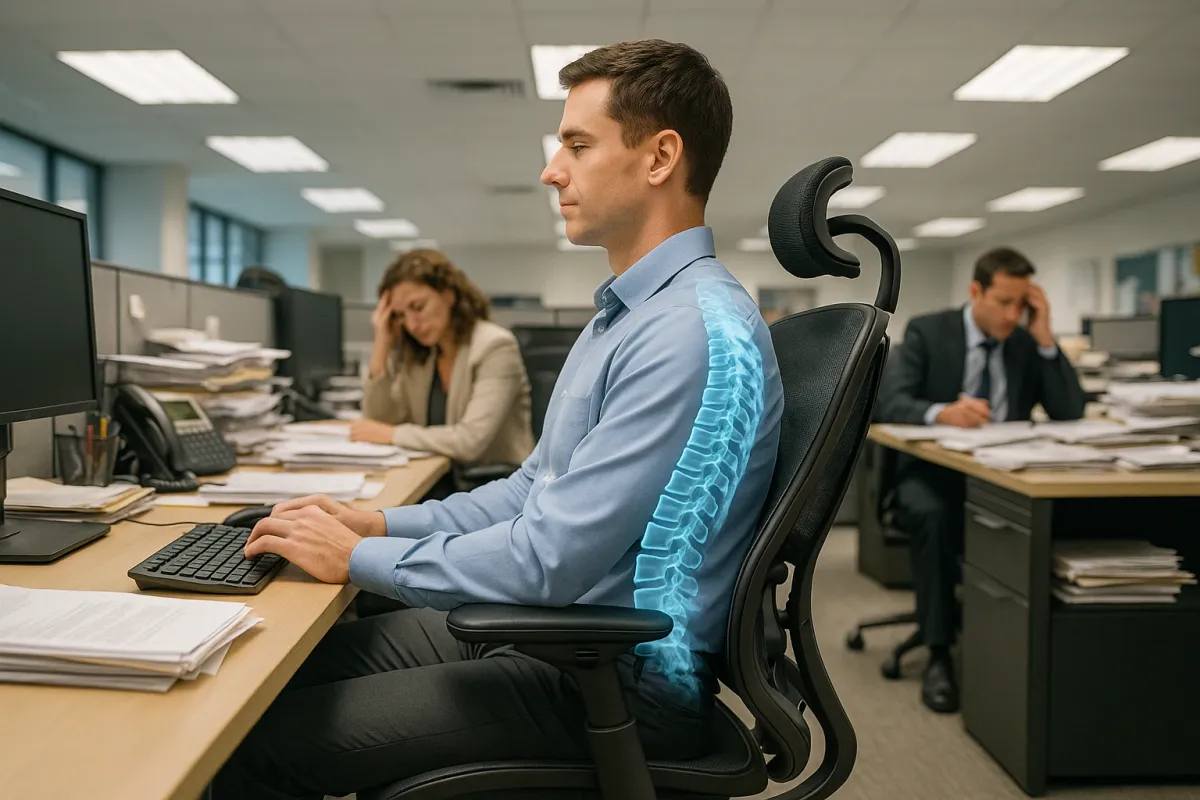
- Desk height and positioning: Tuned so your shoulders are relaxed, elbows near 90 degrees, and your back is not forced into forward flexion to see a screen.
- Monitor placement: At or just below eye level, reducing neck strain and the compensatory rounding that stresses the thoracic and lumbar regions.
- Foot and hip alignment: Feet flat or supported, hips slightly above knee level to maintain a more neutral lumbar curve.
- Light and acoustics: Surprisingly powerful in reducing upper-body tension; visual strain and constant low-level noise both tend to manifest as muscular tightness in the neck and upper back.
Seen through this lens, the individual who arrived at a new job with a personally purchased $1,800 chair was not making an aesthetic statement, but a strategic one. They were bringing their spinal environment with them—portable, calibrated, and non-negotiable.
Conclusion
A disappearing Aeron chair, an incredulous co-worker, and a call to the police: on the surface, it reads like office farce. Yet for those who live with back pain—or are serious about never joining that club—this story is a clarion call. The equipment that supports your spine is not optional, not ornamental, and not communal property to be casually shared away.
The sophisticated approach to back care in the modern workplace is one of deliberate investment, unapologetic clarity, and refined daily practice. Choose (or request) seating that truly serves your spine. Protect it as you would any other medical device. Pair it with movement, mindful posture, and an environment engineered for ease rather than strain.
Viral headlines come and go. Your back, by contrast, is with you for life. Treat it with the same level of seriousness, elegance, and protection that an $1,800 chair so visibly—and controversially—symbolized this week.
Key Takeaway
The most important thing to remember from this article is that this information can change how you think about Back Health.