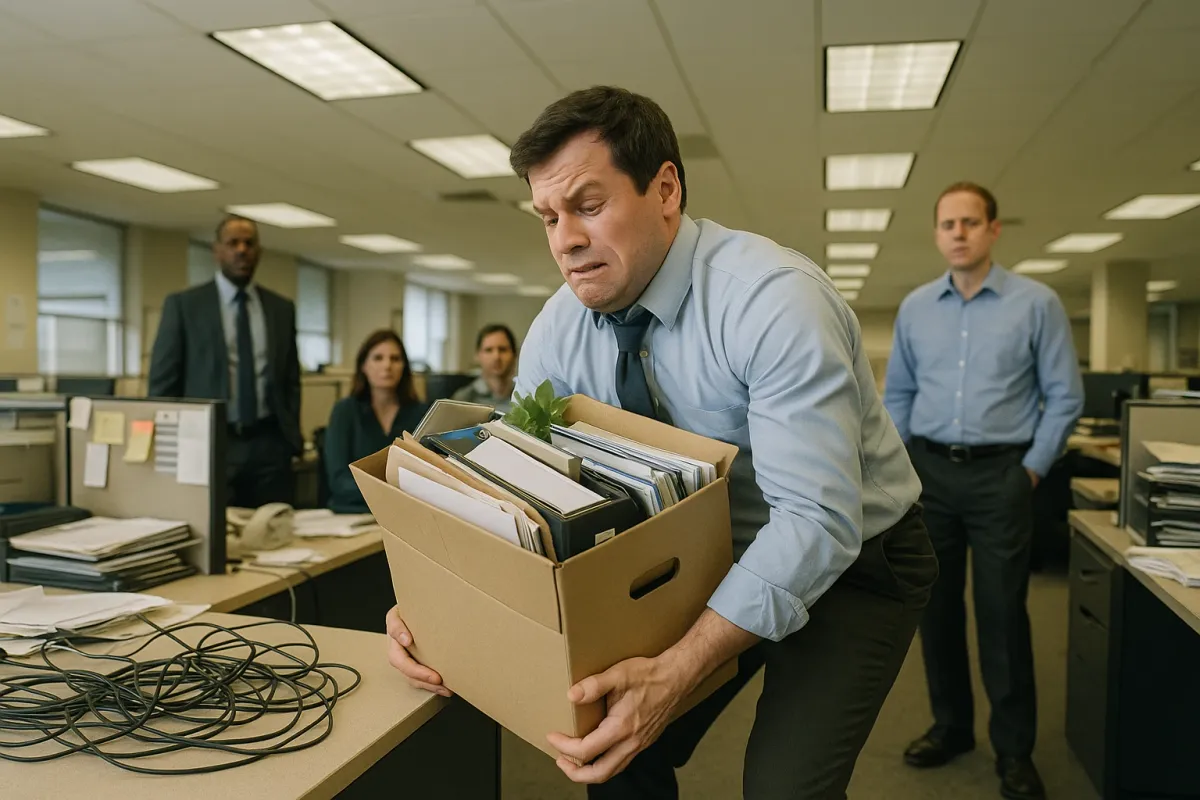
The internet is currently obsessed with “Not My Job” moments—those viral images of workers doing the absolute bare minimum in the most literal way possible. Bored Panda’s trending piece, “People Are Sharing Priceless ‘Not My Job’ Moments Caught In Pictures”, has turned these snapshots of apathy into comic relief: painted leaves, half-finished crosswalks, outlets installed upside down, ramps to nowhere. We laugh because the failures are obvious.
What’s less obvious—but far more consequential—is that the same attitude quietly shapes the spaces we sit, stand, and work in every day. When facilities teams, managers, and even we ourselves treat ergonomics as “not my job,” the result isn’t a funny photo. It’s chronic back pain, creeping fatigue, and a spine that’s being slowly, elegantly overworked into dysfunction.
Today, as millions share those images for a quick laugh, it’s worth asking a deeper question: where is “not my job” quietly sabotaging your back—and what does a more refined, intentional standard of ergonomic care actually look like?
Below are five exclusive, detail‑oriented insights for people who already know their back deserves better than improvisation and guesswork.
1. The Real “Not My Job” Fail: When No One Owns Your Posture Environment
In those viral photos, the problem is painfully clear: someone did the task, but not the outcome. A ramp technically exists, but is unusable. A lane is painted, but misaligned. The job got done, not done well.
Your posture environment—your chair, desk height, monitor placement, lighting, flooring, and daily movement rhythm—often suffers the same fate. IT sets up your monitor “enough to work.” Facilities buys a chair “that looks ergonomic.” You pick a laptop stand “that fits the budget.” No one is accountable for the total experience of your spine across an entire workday.
A premium approach flips that script: your posture environment becomes a designed system, not a pile of parts. The question is no longer “Do I have an office chair?” but “Does every element of this setup collaborate to keep my lumbar spine supported, my thoracic spine relaxed, and my neck in neutral throughout the day?” If you can’t answer that confidently, your back is living in a “not my job” workspace—no matter how expensive the furniture looks.
Practical refinement for your back:
- Choose one person—ideally you—to be the “Chief Ergonomics Officer” of your environment, at home and at work.
- Once a quarter, review your setup with intention: seating, surfaces, screens, lighting, and the paths you walk.
- Ask a single test question: What is my spine being asked to tolerate here, hour after hour? Then adjust accordingly.
2. Invisible Sabotage: How Micro‑Misalignments Quietly Exhaust Your Spine
The photos in the viral “Not My Job” collection are dramatic: road markings painted around fallen leaves, stairs that dead-end at a wall, doors installed where they clearly shouldn’t be. Real‑world ergonomic failures are rarely that photogenic. They are subtle—almost elegant in how quietly they cause damage.
A laptop that is 3 cm too low. An armrest that is 2 cm too high. A chair depth that leaves 1 cm too little space behind your knees. These are not headline-grabbing errors, but they are the ergonomic equivalent of the misaligned crosswalk: technically “fine,” functionally flawed.
For your spine, these micro‑misalignments create constant, low‑grade muscular work. Your neck flexes a few extra degrees. Your lumbar extensor muscles stay slightly “on” to keep you upright. Your shoulders migrate forward by a whisper. Over 8–10 hours a day, this becomes not discomfort, but depletion—an elegant kind of exhaustion that shows up as “I’m just tired” rather than “I’m injured.”
Practical refinement for your back:
- Monitor height: Aim for the top third of the screen at or just below eye level when you are sitting tall.
- Chair depth: When you sit back fully, you should have roughly 2–3 fingers of space between the front of the seat and the back of your knees.
- Armrest height: Your shoulders should feel effortlessly level; if you feel them pushed up or falling down to meet the rests, adjust or lower/remove them.
These fine‑tuning choices are the difference between “it works” and “it works for your spine.”
3. Ergonomic “Aesthetics” vs. Ergonomic Outcomes
Those viral “Not My Job” moments also reveal another pattern: projects completed to satisfy the appearance of completion. A coat of paint over broken concrete. A sign technically installed, but positioned where no one can see it. Visually acceptable, functionally absurd.
The ergonomics market is full of that same energy right now. Fashion‑forward task chairs, sculptural standing desks, minimalist laptop stands—all exceptionally photogenic on social media and in office design features. But a premium aesthetic does not guarantee premium spinal outcomes.
True ergonomic luxury is not what your workspace looks like—it’s how little your back has to negotiate with it.
Practical refinement for your back:
When evaluating any “ergonomic” product—chair, desk, keyboard, cushion—ask three non‑negotiable questions:
Adjustability: Can it be precisely tailored to your body dimensions and preferred tasks, or is it essentially fixed in shape?
Neutral spine support: Does it help your spine hold its natural curves—neck gently in line with torso, thoracic spine relaxed, lumbar gently supported—without constant muscular effort?
Sustainable comfort: Do you feel less back fatigue at the end of the day after using it consistently for two weeks, not just in the first 30 minutes?
If the answer to any of these is “not really,” you are paying for design theater, not back health.
4. When “Minimum Viable Effort” Design Meets Maximum Back Demand
The charm of the “Not My Job” photos lies in their ruthless minimalism: someone did precisely, and only, what the job description required—no more, no less. It’s comic in a parking lot; it’s costly in a workplace designed for knowledge workers whose primary “equipment” is their spine.
Many organizations still treat ergonomics as an HR checkbox: one‑time assessments, generic chairs, a token sit‑stand desk in the corner. It’s a minimum-viable-effort approach, but your back is the one providing the maximum effort to compensate.
A more sophisticated standard recognizes that back care is not a perk; it is infrastructure.
Practical refinement for your back (and for leaders):
- For individuals:
- Treat discomfort as data, not an annoyance to push through. Track when and where your back tightens: mornings at the desk, late afternoons on Zoom, evenings on the sofa. Patterns reveal design flaws.
- Gently rotate your “posture modes” throughout the day: 45–60 minutes sitting supported, 15–20 minutes standing, a few minutes of precise movement (spinal mobility, hip opening) between.
- For managers and founders:
- Stop framing ergonomics as a cost; view it as risk management and performance infrastructure. Musculoskeletal issues remain one of the top drivers of lost productivity and medical claims globally.
- Offer employees more than a chair stipend—offer guidance. A modest budget, paired with curated recommendations and expert input, outperforms a generous budget with zero strategy.
A workplace that quietly demands maximal musculoskeletal effort is simply outsourcing its design problem to your spine.
5. Beyond Furniture: The Micro‑Rituals That Define a Premium Back‑Care Life
The viral “Not My Job” hashtag is so potent because it captures a mindset: I did what I had to. Nothing more. Many of us carry a subtler version of that mindset into how we treat our backs. We buy one good chair, maybe a standing desk, and declare the problem “handled.”
For a spine that already knows pain—disc issues, facet joint irritation, muscular guarding, postural fatigue—furniture is only the starting point. What truly distinguishes a refined, premium approach to back care are the micro‑rituals that frame your day.
Consider elevating your routine with these details:
- A 60‑second posture reset ritual at key transitions: before your first email, after lunch, after your longest meeting, and before you leave your desk. Sit or stand tall, gently lengthen through the crown of your head, soften your ribs, anchor your feet, and allow your lower back to find its natural curve. This is posture as a practiced skill, not a constant strain.
- A “movement minimum” rather than a step minimum. Steps are useful, but your spine thrives on variety: gentle spinal rotations, cat‑camel movements, supported hip flexor stretches, shoulder blade mobility. A 5‑minute, highly intentional sequence twice a day is worth more to your back than 5,000 distracted steps.
- An evening de‑compression ritual that signals to your paraspinal muscles that the workday is truly over. This might be lying on the floor with calves on a chair (to neutralize lumbar load), supported child’s pose, or a few minutes over a foam roller or rolled towel at the mid‑back to gently counteract desk posture.
- A quarterly “back audit.” Just as you would service a fine watch or luxury vehicle, schedule a structured check‑in: with a physio, ergonomist, or skilled bodyworker who understands your work demands. Review flare‑ups, adjust your environment, and refine your routines before small irritations become structural problems.
These rituals are quiet, almost invisible from the outside—no more dramatic than an email or a calendar entry. Yet over months and years, they draw a sharp line between a back that is enduring your life, and a back that is elegantly supported by it.
Conclusion
The “Not My Job” images lighting up timelines this week are amusing precisely because their failures are so obvious. In reality, the most consequential “not my job” moments are the ones no one photographs: the unclaimed responsibility for your posture environment, the invisible misalignments your body compensates for, the minimal effort that becomes your spine’s daily maximum.
A sophisticated approach to ergonomics demands something different: ownership, intentionality, and an insistence on outcomes, not appearances. It’s the quiet decision to treat your back as an asset worthy of design, not as equipment to be tolerated.
In a world that keeps cutting corners for speed and aesthetics, choosing to design your life—and your workspace—for spinal health is a quietly radical act. It won’t go viral on social media. But your back will notice, every hour of every day.
Key Takeaway
The most important thing to remember from this article is that this information can change how you think about Ergonomics.