Back comfort is not a luxury; it is the quiet infrastructure of a high-functioning life. For those who live with back sensitivity—or who simply expect more from their bodies than the average office chair allows—ergonomics is less about generic “good posture” and more about calibration. Thoughtful adjustments, tailored to your body’s proportions and your work style, can transform the way your spine experiences every hour of the day.
This is not a checklist of obvious tips. It is a set of five exclusive, detail-driven insights—small refinements with disproportionately elegant payoffs for people who demand more from their bodies and their environments.
The Micro-Angle Advantage: Why 90 Degrees Is Overrated
The familiar advice to sit at “90 degrees” is, for many, subtly aggravating to the spine. Human joints are not engineered for geometric rigidity; they thrive on slight deviation and variability.
A more spine-savvy approach:
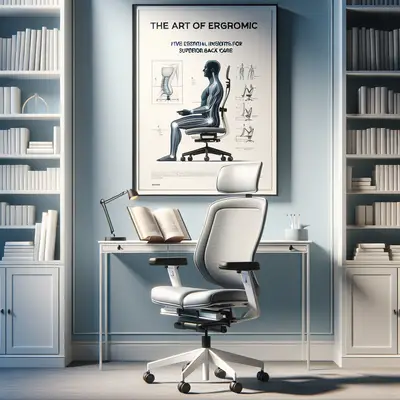
- Hip angle: Instead of 90°, aim for a gentle open angle—approximately 100–110°. This modest recline reduces disc pressure in the lumbar spine compared with rigid upright sitting. A slightly reclined backrest with firm lumbar support often feels immediately more sustainable.
- Knee angle: Your knees should rest at or just below hip height, not sharply bent or tucked under you. If your chair is high, use a footrest to preserve this angle without pulling on the lower back.
- Backrest tilt: A dynamic backrest—tilted slightly backward and allowed to move with you—lets the spinal muscles share the load instead of locking into endurance mode.
The refinement lies in personalization: instead of fixating on “perfect” angles, use 100–110° hip bend and a modest recline as a starting point, then adjust in millimeters until your lower back feels neutrally supported rather than actively braced.
The Quiet Power of Arm Support: Offloading the Spine from the Shoulders Down
For many people with neck, shoulder, or mid-back tension, the real culprit is not the spine itself but unsupported arms. Every gram your shoulders hold up for hours is load translated downward into the spine.
For premium back comfort, arm support becomes non-negotiable:
- Armrests as structural support: Properly adjusted armrests should allow your shoulders to rest—neither hunched nor dropped. Elbows should hover just below a 90° bend, hands gliding naturally toward the keyboard.
- Desk height alignment: If your desk is too high, your shoulders will lift and your upper back will lock. Adjust chair and desk so that your forearms float parallel to the desk, supported either by the armrests or the desk edge itself.
- Laptop and tablet considerations: Typing with forearms unsupported on a sofa, bed, or café bench is brutal for the upper back. A portable, slim arm-support or using the table edge as forearm support can dramatically reduce accumulated strain.
When arms are supported with precision, the spine is no longer forced into reluctant service as a suspension bridge. Subtle as it seems, this alone can be the difference between an evening marked by dull ache and one marked by ease.
The Visual Horizon: Calibrating Screens to Calm the Spine
The spine responds directly to where the eyes are compelled to look. Screen position is, functionally, spinal architecture.
Refined visual ergonomics goes beyond “put the monitor at eye level”:
- Primary gaze angle: Most people are most comfortable with their eyes gazing slightly downward—about 15–20° from horizontal. This allows a gentle neck flexion that feels natural while avoiding the heavy forward head posture linked to neck and upper back pain.
- Distance, not just height: A good rule is roughly an arm’s length between your body and the main screen, adjusted so your neck doesn’t lean forward to “chase” details. If you find yourself squinting or leaning in, increase font size or contrast rather than inching forward.
- Multi-screen hierarchy: If you use multiple monitors, one should be clearly designated as primary and placed directly in front of you. Secondary screens should sit slightly to the side, not forcing you into constant trunk rotation or fixed head turning.
- Mobile integration: Looking down at a phone or tablet repeatedly—“tech neck”—defeats the most elegant desk setup. A stand that lifts your phone to near-monitor height, even slightly off to the side, respects your cervical spine and aligns your habits with your environment.
A well-positioned screen creates a “visual horizon” that your head and neck can settle into, reducing the micro-tension that accumulates invisibly but is deeply felt by anyone with a sensitive back.
The Floor as a Tool: Foot Position as Spinal Strategy
The floor is often treated as a passive surface, but for the spine, it is a silent partner. When feet hang, twist, or push awkwardly against chair bases or furniture edges, the pelvis is subtly rotated or tilted—and the spine compensates.
A more intentional relationship with the floor looks like this:
- Full contact: Both feet should rest flat, with weight evenly distributed across heels and forefoot. Dangling feet or tiptoeing to meet the ground pulls on the low back via the hamstrings and hips. A simple footrest—often underappreciated—can make an immediate difference.
- Hip-neutral stance while seated: If one leg tucks under you or wraps behind the chair, your pelvis rotates, often imperceptibly. Over time, this asymmetry becomes a low-level twist through the lumbar and thoracic spine. Train yourself to “reset” both feet forward and flat each time you return to focused work.
- Micro-mobility for circulation: Elegance in ergonomics includes circulation. Subtle foot movements—alternating heel lifts, toe taps, or slow ankle circles—support blood flow without disturbing posture. Think of it as silent maintenance for the lower body that indirectly protects the back.
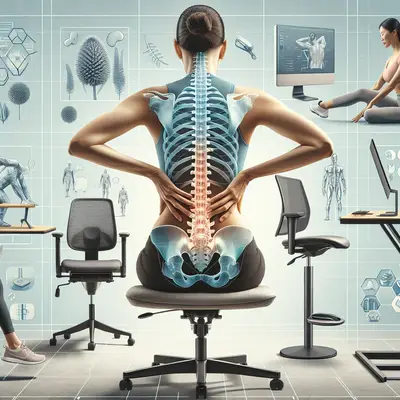
Once you make the floor an active element of your ergonomic design, your pelvis finds a more stable, neutral position. The spine, no longer correcting for lower-body imbalance, can rest in alignment rather than constant micro-compensation.
The Ritual of Transitions: Protecting the Back Between Postures
People often obsess over sitting posture while neglecting the transitions that quietly provoke discomfort: standing up, sitting down, bending to pick something up, or shifting from desk to sofa. For sensitive backs, these micro-movements are where the real risk—and opportunity—lie.
Integrating refined transition habits into your day:
- Standing from sitting: Scoot to the front of the chair, place both feet firmly under your knees, hinge slightly forward from the hips with a straight (not rigid) spine, and use your legs to rise. Avoid using the backrest as a launchpad or rounding the spine to “heave” yourself upward.
- Returning to the chair: Instead of dropping into the seat, lower yourself with deliberate control. Light hand contact on the armrests or desk, a soft hip hinge, and an awareness of where the chair is creates a smoother load transfer through the spine.
- Desk-to-floor or low surfaces: If you work with files, children, or objects on the floor, train yourself in hip hinging and partial squats rather than collapsing forward at the waist. A neutral spine with near-vertical shins is far kinder than repeated spinal flexion under load.
- Micro-pauses: Each time you transition—from email to a call, from focused writing to a meeting—take three seconds to extend the spine gently, relax the jaw, and let your shoulders settle. This brief reset can prevent low-grade tension from stacking into evening pain.
Those who live with back issues notice these transitions most; those who care for their backs intentionally refine them. It is this choreography between postures—not just the postures themselves—that defines truly elevated ergonomic behavior.
Conclusion
Exceptional back care is not about chasing an unattainable “perfect posture.” It is about orchestrating small, precise conditions that allow the spine to work with you, rather than in spite of your environment. Micro-angles at the hips, intelligent arm support, calibrated visual horizons, intentional foot placement, and elegant transitions between postures—these are the quiet design principles of a workspace worthy of a discerning spine.
Ergonomics, at its highest level, is not decorative. It is structural self-respect. When you refine the way your body meets your workspace, you are no longer merely sitting or standing; you are curating the daily experience of your spine with the same care you might devote to any other premium element of your life.
Sources
- [National Institute for Occupational Safety and Health (NIOSH) – Computer Workstations](https://www.cdc.gov/niosh/topics/ergonomics/default.html) - Practical, research-informed guidance on optimizing workstation setup to reduce musculoskeletal strain.
- [Mayo Clinic – Office Ergonomics: Your How-To Guide](https://www.mayoclinic.org/healthy-lifestyle/adult-health/in-depth/office-ergonomics/art-20046169) - Overview of evidence-based ergonomic recommendations for chairs, desk height, and screen placement.
- [Harvard Health Publishing – Is Sitting the New Smoking?](https://www.health.harvard.edu/staying-healthy/is-sitting-the-new-smoking) - Discusses the health implications of prolonged sitting and the importance of movement and posture variation.
- [OSHA – Computer Workstations eTool](https://www.osha.gov/etools/computer-workstations) - Detailed federal guidance on ergonomic setup, including seating, monitors, and input devices.
- [Cleveland Clinic – Back Pain: Prevention](https://my.clevelandclinic.org/health/articles/4494-back-pain-prevention) - Evidence-based strategies for everyday back pain prevention, including posture and body mechanics.
Key Takeaway
The most important thing to remember from this article is that this information can change how you think about Ergonomics.