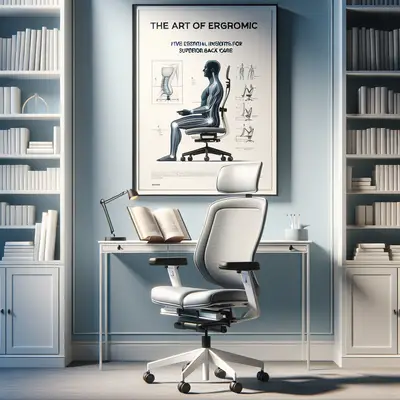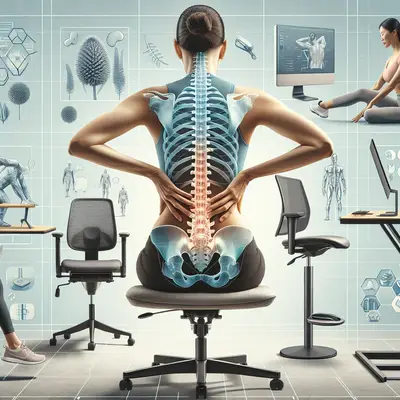
There is a quiet intelligence in how you sit, stand, and move through your day. For those who live with back discomfort—even intermittently—ergonomics is no longer a corporate buzzword; it is a form of precision care. When refined, it transforms the ordinary rituals of work, rest, and leisure into a subtle system of spinal protection. This is not about buying the most expensive chair in the room—it is about orchestrating a deliberate environment in which your back is no longer an afterthought.
Beyond the Chair: Designing a Complete Ergonomic Field
Most people equate ergonomics with a single object—a chair, a desk, or perhaps a standing setup. In reality, your spine experiences your entire environment as a continuous “field”: seating, screen, lighting, floor surface, arm support, and even the angle of your keyboard. When one element is misaligned, the others are forced to compensate, often at your back’s expense.
Begin by thinking spatially, not just in terms of furniture. Your eyes should meet the upper third of your screen without tilting your head; your elbows should fall naturally close to your body when you type; your feet should rest fully on a stable surface, not dangle or strain. Add supportive elements in layers: a slight footrest if your legs don’t comfortably reach the floor, a thin lumbar support instead of an oversized cushion, a light under the monitor to reduce forward head posture driven by squinting. The goal is a precise, tailored environment, not visual drama.
Exclusive Insight #1: Treat ergonomics as a field, not a single object. Evaluate how every element—chair, desk height, lighting, and floor—collectively influences your back, instead of fixating on one “hero” product.
Micro-Postures: The Fine Art of Subtle Movement
Staying “perfectly straight” all day is not a sign of discipline; it is a pathway to fatigue. Your spine is built for nuanced motion, not rigid stillness. Micro-postures—subtle, frequent shifts in how you sit and stand—are one of the most powerful yet underappreciated tools in protecting your back.
Think of posture in terms of a range, not a single ideal position. A slight tilt forward, a gentle recline, a momentary cross-uncross of ankles: these light adjustments distribute pressure across different areas of the spine, discs, and supporting muscles. A well-designed chair or workstation should invite these micro-movements, not trap you in one fixed stance. Set discreet cues—a soft chime every 30–45 minutes or a watch reminder—to encourage small posture refinements rather than major, disruptive breaks.
Exclusive Insight #2: Replace “perfect posture” with a refined repertoire of micro-postures. Gentle, frequent adjustments are more protective than obsessing over one ideal position.
Precision in Angles: Calibrating Your Spine’s Everyday Geometry
The body is exquisitely sensitive to angles. A few degrees of misalignment—at your neck, hips, or wrists—can translate into hours of accumulated strain. When you think ergonomically, begin to notice angles as you would note fine details in a carefully designed object.
Aim for a neutral neck angle: your ears in line with your shoulders, your gaze level rather than tilted downward toward a laptop. Your hips should ideally rest just slightly higher than your knees, encouraging a subtle forward tilt of the pelvis that supports the natural curve of your lower back. Wrists should float in a neutral line with your forearms, not bent upward or downward toward the keyboard. Raise the monitor instead of your chin; adjust the seat height instead of accepting compressed hips; bring the work to you instead of reaching forward and rounding your spine.
Exclusive Insight #3: Treat angles as a precision instrument for back comfort. Even minor refinements—hip height, monitor level, wrist line—can materially decrease spinal strain over the course of a day.
The Understated Power of Surfaces: What Your Back Feels, Your Nervous System Remembers
The surfaces that meet your body send continuous signals to your muscles and nervous system. A seat that is too soft encourages collapse and slouching; one that is too firm creates pressure points that your body tries to escape by twisting or leaning. The same is true for the ground beneath your feet and the support under your wrists.
Seek surfaces that are quietly responsive rather than dramatic: a seat with balanced firmness and minimal slope; a backrest that meets the natural lumbar curve rather than forcing it; a lightly cushioned mat if you stand for long periods. Pay attention to how your body behaves unconsciously: if you constantly shift to one side of a chair or lean on one elbow, your surfaces are likely encouraging asymmetry. Correcting this is less about luxury and more about discernment—choosing materials and contours that allow your spine to rest in neutrality without constant muscular negotiation.
Exclusive Insight #4: Surfaces shape your unconscious posture. The feel of your chair, floor, and supports either invite symmetry and ease—or quietly train your back into imbalance.
Ergonomics as a Daily Conversation with Your Back
Perhaps the most refined approach to ergonomics is to treat it as an ongoing dialogue with your body, not a one-time setup. Back discomfort is often a message, not a malfunction. Instead of silencing it entirely, use it as feedback to recalibrate your environment.
Notice what time of day your back begins to complain, and where. Morning stiffness may point to sleep ergonomics—mattress, pillow, or side-sleeping posture. Afternoon tightness in the lower back might signal too many hours in hip-flexion at the desk without standing variation. Upper back fatigue in the evening may reflect a day of forward head posture and unsupported arms while typing or holding a phone. Each pattern is an invitation to refine: adjust the chair angle, elevate the screen, introduce a standing interval, or reposition the keyboard.
Exclusive Insight #5: Let discomfort guide intelligent adjustment, not panic. When your back speaks up, use that signal to fine-tune your ergonomics with small, targeted changes instead of dramatic overhauls.
Conclusion
Ergonomics, at its most elevated, is not about aggressive interventions or conspicuous equipment. It is a considered practice: aligning space, angles, surfaces, and subtle movement to honor the architecture of your spine. For anyone living with back issues, this is not indulgence—it is strategic preservation. By treating your environment as a refined instrument rather than a fixed backdrop, you give your back something it rarely receives in modern life: quiet, continuous respect.
Sources
- National Institute of Neurological Disorders and Stroke – Low Back Pain Fact Sheet - Overview of causes, risk factors, and management strategies for low back pain
- Mayo Clinic – Office ergonomics: Your how-to guide - Practical, evidence-informed guidance on optimal desk and workstation setup
- Occupational Safety and Health Administration (OSHA) – Computer Workstations eTool - Detailed ergonomic recommendations for seated and computer-based work
- Harvard Health Publishing – The importance of good posture - Discussion of posture’s impact on spine health and muscular strain
- Cleveland Clinic – Ergonomics: How to make your work-from-home office safer - Clinical insights on adapting everyday environments to reduce back and neck strain
Key Takeaway
The most important thing to remember from this article is that this information can change how you think about Ergonomics.