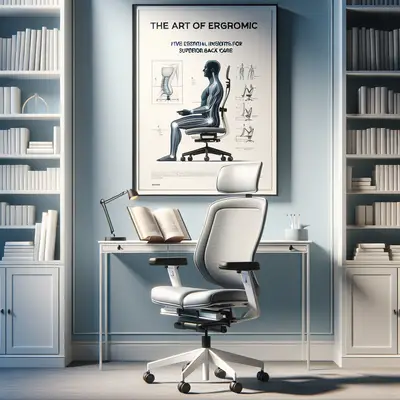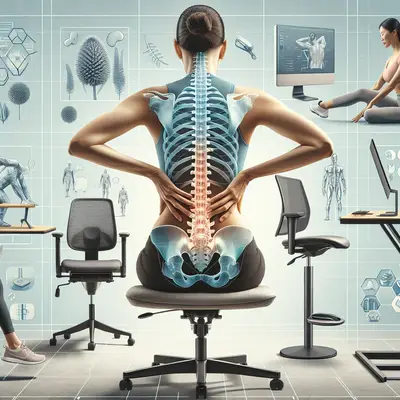
Back pain rarely announces itself with drama at first. It arrives quietly—an ache at 4 p.m., a stiffness after a short drive, a reluctance to bend or twist quite as freely as you once did. Ergonomics, at its best, is the art of redesigning the everyday so those whispers never become a roar. This is not about trendy chairs or gadgets; it is about cultivating a precise relationship between your body, your tools, and your environment—at work, at home, and everywhere in between.
Below are five exclusive, underappreciated ergonomic insights for those who already know the basics and are ready to refine them into something truly protective, sustainable, and quietly luxurious for the spine.
The Micro-Environment Principle: Designing the 18-Inch Radius Around Your Spine
Most ergonomic advice focuses on “the workstation.” In reality, your spine experiences the world within an intimate, 18-inch bubble: the space from your torso to your hands, eyes, and tools. Refined ergonomics begins with engineering this micro-environment, not merely adjusting a chair.
For desk work, everything you use repeatedly—keyboard, mouse, primary notebook, glass of water, phone—should live within this primary reach zone, so your elbows remain close to your sides rather than drifting forward. Forward reaching may feel harmless, but it subtly pulls your head and shoulders ahead of your center of gravity, increasing the load on your lumbar region and amplifying neck tension. The same principle applies in the kitchen (positioning frequently used items between waist and chest height) and in the car (adjusting the seat so steering and controls are a natural, close reach). When your daily tools come to you—as if on a well-orchestrated stage—your back stops paying the price for poorly planned distance.
The Vertical Gaze Rule: Calibrating Screens as Spine Preservation
Eye level is not a vanity metric; it is a spinal strategy. When your screen (laptop, monitor, or even cookbook on the counter) sits too low, your head drifts forward and down. For every inch your head moves ahead of your shoulders, the effective load on your neck and upper back increases dramatically. Over the course of a day, this becomes a quiet assault on the cervical and thoracic spine.
The refined approach is to engineer your vertical gaze. Your primary screen should be directly in front of you, with the top of the visible display at or slightly below eye level. If you wear progressive lenses, you may need to lower the screen slightly to avoid constant neck extension. Laptops almost never meet this criterion on their own; pairing a laptop stand with an external keyboard and mouse transforms a portable device into a spine-respecting workstation. Consider replicating this logic wherever you read: raising tablets on stands, propping books, or even using a cookbook holder in the kitchen. Your spine should not have to “bow” to your technology.
Hypermobility vs. Hypomobility: Matching Ergonomics to Your Spinal Personality
Ergonomic advice often assumes everyone’s spine behaves the same way. In reality, how you set up your environment should be influenced by whether your back tends toward stiffness (hypomobility) or excessive looseness (hypermobility).
If your spine is relatively stiff, you often benefit from more movement opportunities: a sit-stand desk, regular positional changes, gentle rotation and extension breaks, and chairs that allow subtle motion rather than rigid lock-in. Your ergonomics should encourage carefully dosed mobility so your back doesn’t “freeze” into one posture.
If your joints are naturally loose or hypermobile, too much motion and slouching can be destabilizing. You may need a firmer chair, clearer lumbar support, and more deliberate control over posture. For you, “ergonomic” may mean less wobble and more stable contact, especially through the pelvis and feet. Cushions, wedges, and footrests can help define alignment so your body doesn’t sink into positions that place excess demand on supporting ligaments.
A sophisticated ergonomic plan begins with this personal audit: Is my back under-moving or over-moving? Your environment should compensate, not copy a generic template.
The Transitional Zones: Doorways, Cars, and the Hidden Risk of In-Between Movements
Most people consider ergonomics only where they “stay”: at a desk, in bed, on the sofa. Yet many back aggravations occur in transitional zones—getting in and out of a car, bending into the dishwasher, lifting luggage into the trunk, twisting to reach a back seat, or leaning over a bathroom sink.
These in-between moments deserve the same design attention as your chair. For example, when entering a car, sit first with both feet on the ground, then rotate your whole body as a unit, bringing your legs in together rather than twisting through the lower back. When loading a dishwasher or front-loading washer, open the door fully and hinge at the hips with a slight bend in the knees, rather than rounding the spine. When brushing your teeth or washing dishes, bring yourself closer to the sink—with one foot slightly forward or resting on a low footstool—to minimize sustained forward bend through the lumbar region.
Elegant ergonomics views your home, office, and car as a series of “movement interfaces.” By smoothing these transitions, you eliminate countless micro-strains that accumulate into end-of-day pain.
Postural Pacing: Timed Variation as a Luxury for the Spine
There is no perfect posture that can be held indefinitely without cost. The true luxury is not a single ideal position, but the freedom—and deliberate structure—to change positions before discomfort demands it. This is postural pacing: changing what your spine is doing, proactively, on a schedule.
A refined rule of thumb: change something every 20–30 minutes. This doesn’t always mean standing; it can be as subtle as adjusting seat depth, shifting from a more reclined to a more upright posture, uncrossing legs, placing feet on a footrest, or briefly standing and leaning your hands on the desk for gentle spinal decompression. For longer tasks, think in 60–90-minute cycles that include a short walk, a few controlled hip hinges, or a brief stretch for the chest and hip flexors to counter prolonged sitting.
To support this, consider using soft cues rather than jarring alarms: a subtle desktop reminder, a smart watch vibration, or pairing position changes with routine events (every new email batch, every phone call, every cup of tea). Over time, postural pacing becomes a quiet ritual of respect for your spine’s limits—preventing pain, rather than reacting to it.
Conclusion
Ergonomics is not merely a set of adjustments; it is a philosophy of how you move through your day. When you respect the 18-inch micro-environment around your spine, align your gaze with your devices, tailor your setup to your spinal “personality,” refine the way you handle transitions, and adopt postural pacing as a daily ritual, your back becomes less of a liability and more of a quiet asset.
The most effective ergonomic choices rarely draw attention. They simply allow you to work, travel, cook, read, and live with a sense of unremarkable ease. That, in itself, is a form of luxury.
Sources
- National Institute of Neurological Disorders and Stroke – Low Back Pain Fact Sheet - Overview of causes, risk factors, and management of low back pain
- Mayo Clinic – Office Ergonomics: Your How-To Guide - Practical guidance on workstation setup and posture considerations
- Occupational Safety and Health Administration (OSHA) – Computer Workstations eTool - Detailed recommendations on positioning of screens, input devices, and seating
- Harvard Health Publishing – Prolonged Sitting and Back Pain - Discussion of how sustained sitting impacts spinal health and strategies to reduce strain
- Cleveland Clinic – Hypermobility: What It Is, Symptoms & Treatment - Explanation of joint hypermobility and its implications for movement and support
Key Takeaway
The most important thing to remember from this article is that this information can change how you think about Ergonomics.