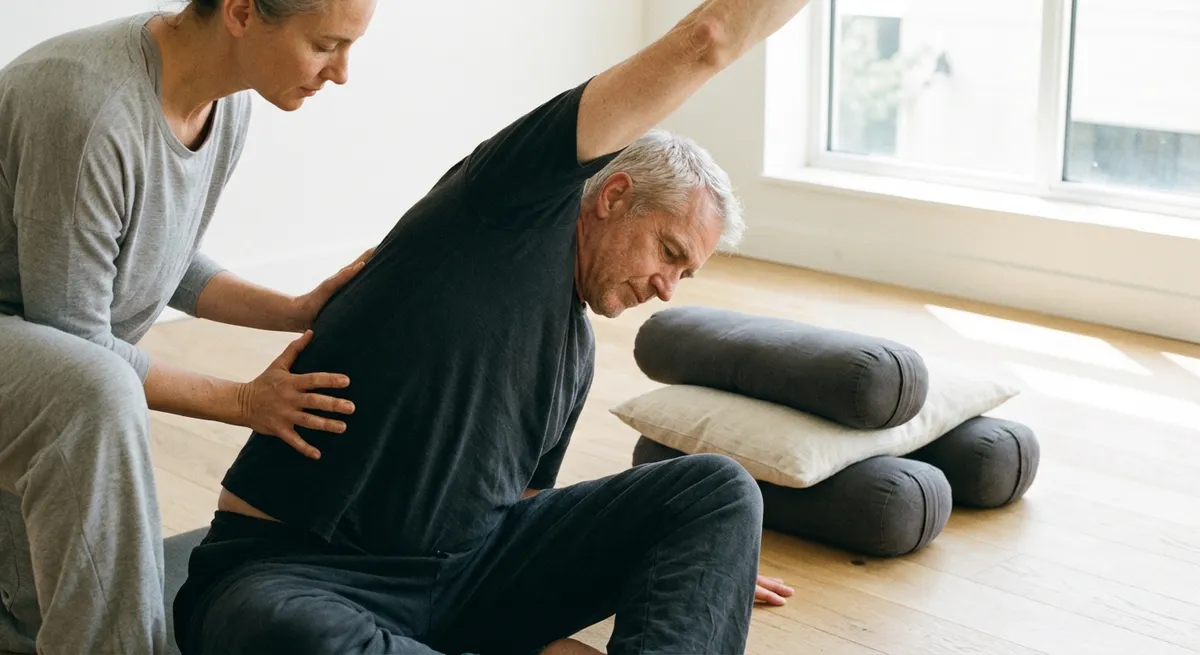
Back care, at its most elevated, is no longer about “pushing through” or chasing quick fixes. For those who expect more from their bodies—and their healthcare—exercise therapy offers a quieter, more intelligent path: precise movement as medicine, administered with intention rather than intensity. When curated carefully, an exercise program for back health becomes less of a workout and more of a private, ongoing consultation with your nervous system, your posture, and your long‑term quality of life.
This is not fitness culture. This is refinement in motion.
Exercise Therapy as a Dialogue, Not a Prescription
Most people experience exercise as a directive: “Do three sets of ten.” Back‑focused exercise therapy, when thoughtfully designed, functions more like a conversation between your body and your brain.
Each movement becomes diagnostic: How does your spine respond to extension versus flexion? Do rotational patterns provoke symptoms or ease them? What happens to your pain when your breathing slows and deepens? A skilled physical therapist or movement specialist listens to these responses and adjusts the plan in real time.
This conversational approach has two benefits. First, it respects the individuality of your spine—its history of injuries, your work demands, your sleep patterns, your stress load. Second, it trains you to become fluent in your own physical signals. Instead of fearing every twinge, you begin to recognize patterns: which movements restore you, which postures subtly drain you, which days require restraint rather than ambition.
The result is an exercise practice that evolves with you, rather than one that asks you to contort your life—and your spine—around a generic routine.
Insight 1: Precision Beats Intensity for a Sophisticated Spine
A premium approach to back care prioritizes precision over spectacle. The small, often “unimpressive” exercises—controlled pelvic tilts, segmental bridges, deep abdominal activations, subtle hip rotations—are where the most meaningful recalibration occurs.
High‑intensity routines may deliver sweat and endorphins, but for a vulnerable or historically irritated spine, they can also reinforce dysfunctional patterns. Precision work does the opposite: it interrupts your autopilot. By slowing movement and limiting load, you give your body space to relearn safer recruitment strategies.
For people accustomed to performance metrics, this can feel almost too understated. Yet elite rehabilitation protocols for athletes and performers are built on the same principle: exactness first, exertion later. A precise ten‑minute routine, executed flawlessly, can yield more durable relief than an hour of unfocused effort.
Over time, this precision cultivates a different kind of strength—organized strength. Your spine becomes less about “bracing everything” and more about the right muscle, at the right time, with the right amount of effort.
Insight 2: The Nervous System Is the True Gatekeeper of Back Comfort
Premium back care acknowledges that you’re not just conditioning muscles—you’re conditioning your nervous system. Pain lives there. So does protection, guarding, and tension. Exercise therapy for back issues must therefore be as much about recalibrating sensitivity as about building capacity.
Gentle, graded movement exposes your nervous system to positions it may have flagged as “unsafe” in the past. By approaching these positions slowly and without threat—supported, guided, and well‑paced—you send a different signal: this is manageable, this is allowed, this is not an emergency.
Breathing is an underappreciated co‑therapist in this process. Coordinating exhalation with effort, or pairing slow diaphragmatic breathing with low‑load spinal movements, can soften muscular guarding and reduce perceived threat. Over time, many people find that the same movements that once triggered pain become neutral, and sometimes even soothing.
This isn’t psychosomatic in the dismissive sense; it is the integrated reality of modern pain science. A sophisticated spine program respects the nervous system as the ultimate arbiter of comfort, and it therefore uses exercise as a series of carefully graded reassurances.
Insight 3: The Hips and Ribcage Quietly Decide How Your Back Feels
A refined exercise program for back care rarely starts with the back itself. It starts with the structures that quietly dictate what the spine must compensate for: the hips, the pelvis, and the ribcage.
Stiff hips force the lower back to twist and bend more than it should during walking, sitting, or lifting. A rigid ribcage pushes the mid‑back to act as a hinge rather than a smooth curve. Tight shoulders can drag the upper spine into a constant forward fold. These are the silent architects of many chronic back complaints.
Restorative exercise therapy therefore gives generous attention to hip rotation, glute activation, thoracic mobility, and scapular control. An elegant program may include long, deliberate stretches for the front of the hips, spiraling movements for the ribcage, and targeted strengthening for the deep muscles around the pelvis.
The paradox is that your back often improves most not when you “attack” it directly, but when you free the structures above and below it. The spine then returns to its intended role: a gracious mediator of forces, rather than a reluctant shock absorber of everyone else’s stiffness.
Insight 4: Micro‑Sessions Outperform Occasional Grand Gestures
The spine responds better to consistency than to heroics. Ten immaculate minutes, woven into your day with ritual‑like regularity, can be more transformative than a single weekly hour of ambitious effort.
Micro‑sessions—brief sequences of three or four well‑chosen exercises—offer several advantages:
- They respect attention span and energy levels, particularly during flare‑ups.
- They are easy to anchor to daily habits: after your morning coffee, between calls, before bed.
- They reduce the internal resistance that comes with “I need to find an hour.”
- They allow your nervous system to receive frequent, low‑threat reminders of safe movement.
For people who value discretion and efficiency, this approach is particularly appealing. Your spine care can be almost invisible to others: a brief standing routine between meetings, a breathing sequence before sleep, a minute of hip mobility before you step into the car.
Over weeks and months, these micro‑sessions function like compound interest. They quietly accumulate, re‑educating tissues, restoring confidence in motion, and keeping your back from drifting back toward old patterns of stiffness and strain.
Insight 5: Back Care Becomes Sustainable When It Reflects Your Aesthetic and Lifestyle
Exercise therapy for the spine is far more sustainable when it feels congruent with who you are. A refined back care practice does not ask you to become someone else; it integrates into the life you already lead, with minimal friction and maximal respect for your preferences.
For some, this means a curated home setup: a high‑quality mat, a small selection of resistance bands, a low stool, perhaps a mirror for alignment checks. For others, it may mean private sessions rather than group classes, or virtual consultations rather than crowded clinics.
A sophisticated program also acknowledges your aesthetic sensibilities. Precise, well‑timed movements, quiet breathing, and controlled transitions can evoke something closer to a movement meditation than a gym session. This is especially important if you’re someone who values subtlety over spectacle; your back care should feel like a continuation of your taste, not an interruption of it.
When your exercise therapy feels aligned with your standards—well‑designed, thoughtfully sequenced, and respectful of your time—it ceases to be a chore. It becomes a self‑care standard, as expected and non‑negotiable as quality sleep or considered nutrition.
Conclusion
The most effective back‑focused exercise therapy is neither loud nor dramatic. It is composed, observant, and quietly exacting. It respects the spine as part of a larger system—the hips and ribcage that shape its workload, the nervous system that governs its comfort, the lifestyle that sets its daily demands.
For those who approach their health with discernment, this is the true luxury: a movement practice that is not about chasing intensity, but about cultivating mastery; not about punishing a painful back, but about re‑educating it with patience and precision.
In the end, the refined spine is not the one that never feels discomfort. It is the one that knows how to return, again and again, to ease—through deliberate movement, informed choices, and a quietly intelligent relationship with exercise.
Sources
- [American Academy of Orthopaedic Surgeons – Low Back Pain Exercise Guide](https://orthoinfo.aaos.org/en/recovery/low-back-pain-exercise-guide) – Practical overview of evidence‑based exercises for low back pain and their rationale.
- [National Institute of Neurological Disorders and Stroke – Low Back Pain Fact Sheet](https://www.ninds.nih.gov/health-information/disorders/low-back-pain) – Detailed discussion of causes, treatments, and the role of physical activity in back pain management.
- [Harvard Health Publishing – How to Ease Chronic Low Back Pain](https://www.health.harvard.edu/pain/how-to-ease-chronic-low-back-pain) – Explores the importance of exercise, movement therapies, and lifestyle in chronic back pain.
- [Mayo Clinic – Back Pain: Self-Care](https://www.mayoclinic.org/diseases-conditions/back-pain/in-depth/back-pain/art-20043992) – Guidance on activity modification, exercise, and non‑surgical strategies for back pain relief.
- [National Institute for Health and Care Excellence (NICE) – Low Back Pain and Sciatica in Over 16s](https://www.nice.org.uk/guidance/ng59) – Clinical guideline emphasizing exercise and physical activity as core treatments for low back pain.
Key Takeaway
The most important thing to remember from this article is that this information can change how you think about Exercise Therapy.