Ergonomics, at its best, is not a checklist—it is a quiet choreography between your body, your environment, and your ambitions. For those who live with back issues, this choreography becomes non‑negotiable. It is the difference between a day that erodes you and a day that supports you. In a world of generic advice and one‑size‑fits‑all “fixes,” refined ergonomics is about nuance: how a few precise adjustments can transform your spine from merely coping to quietly thriving.
Below are five exclusive, detail‑driven insights designed for people who already understand the basics—and are ready to elevate their back care to a more discerning standard.
1. The Micro-Posture Principle: Why Your “Average” Alignment Matters More Than Perfect Form
Most ergonomic guidance obsesses over “perfect posture,” as if there were a single correct way to sit or stand. In reality, your spine experiences thousands of tiny postures throughout the day, and it is the average of these micro‑positions that shapes your comfort and long‑term health.
Instead of chasing static perfection, focus on reducing the extremes and refining the middle. Think of your posture as a narrow, comfortable corridor rather than a single rigid line. You do not need to sit like a statue; you need to oscillate gently around a stable, supported center. This is where well‑designed lumbar support, correctly adjusted armrests, and a monitor at a natural eye line do their subtle work—they prevent you from drifting into the extremes of flexion (slouching) or extension (over‑arched back) for hours at a time.
For those with existing back pain, this shift in perspective is liberating. Your goal is not to hold an impossible pose, but to curate an environment that makes healthy micro‑postures your default. The more the room does the work, the less your spine has to.
2. Load Distribution as a Luxury: Teaching Your Environment to Carry Its Share
Sophisticated ergonomics is fundamentally about distribution—of weight, of pressure, of effort. Back pain often emerges when one segment of the spine is repeatedly over‑assigned the task of support. A refined setup deliberately diffuses this burden.
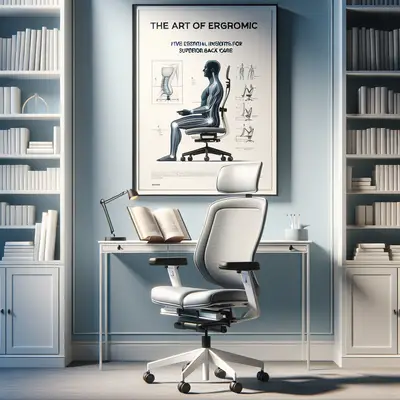
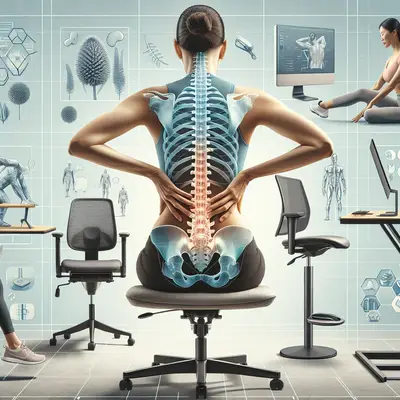
At your desk, this begins with the triangle of support: feet, pelvis, and forearms. Feet belong fully grounded, not wrapped around chair legs or hovering on tiptoe. Your pelvis should rest on a seat that supports the sit bones without cutting into the thighs, allowing the lower back to retain its gentle inward curve. Forearms should be lightly supported by armrests or the desk surface, so your shoulders are not perpetually suspended in a low‑grade shrug.
Beyond the desk, distribution becomes a principle for daily life: a well‑balanced bag instead of a single‑strap tote; a mattress and pillow combination tailored to your sleeping position; a carry strategy that alternates sides rather than defaulting to the same hand or shoulder. Think of every object you touch as a collaborator in weight‑bearing. The more elegantly your environment participates, the less your spine is forced into chronic overperformance.
3. Temporal Ergonomics: Designing Not Just Your Space, but Your Schedule
Most ergonomic advice treats time as an afterthought: “take breaks every 30 minutes.” For a discerning spine, the relationship with time deserves more precision. How long you sustain a position can matter as much as how ideal that position is.
This is where temporal ergonomics comes in—curating when you do things, not just how. If your back tends to stiffen in the morning, you may schedule deep-focus seated work later in the day and prioritize lighter, more mobile tasks earlier. If prolonged sitting aggravates your lower back, you might structure your day into alternating modes: 25–40 minutes of focused seated work, followed by 3–5 minutes of deliberate, spine‑friendly movement.
Rather than treating breaks as interruptions, refine them as essential components of your ergonomic design. A brief standing stretch at the window, a slow walk down the corridor, or a few controlled spinal mobility movements can reset your muscles and reduce cumulative load. Over time, this structured cadence becomes a protective rhythm: your schedule itself becomes an ergonomic asset.
4. The Tactile Intelligence of Surfaces: How Texture and Feedback Guide Better Alignment
People with back issues often underestimate the role of how a surface feels against the body. Texture, firmness, and subtle tactile feedback can either guide you toward supportive alignment or silently invite you into collapse.
A seat that is too soft allows you to sink into a rounded spine; one that is too rigid punishes any attempt at natural movement. The premium zone is a surface that offers gentle, responsive resistance: soft enough to be comfortable, firm enough to signal when you begin to slouch or lean excessively. This applies not only to chairs, but to backrests, car seats, and even headboards and pillows.
Consider how textures cue your behavior. A height‑adjustable desk with a slightly cooler, smooth surface may remind you to rest your forearms lightly and relax your shoulders. A subtly contoured lumbar cushion can provide constant, non‑intrusive feedback that reconnects you with your neutral spine. For those living with pain, these micro‑sensations can become quiet guides—reminding you, without strain or vigilance, to return to a position that your back can sustain gracefully.
5. Ergonomics as Personal Signature: Aligning Your Setup with Your Actual Life, Not an Idealized One
The most refined ergonomic environment is not the one that looks perfect in a catalog; it is the one that harmonizes with the way you genuinely live and work. Back care becomes exceptional when ergonomics aligns with your real patterns, preferences, and constraints.
If you spend evenings reading on a sofa rather than at a desk, that seating arrangement deserves as much intentionality as your office chair. If you work across multiple locations—home, office, travel lounges—your ergonomic strategy must be portable: a compact lumbar roll, a lightweight laptop stand, or a simple routine for transforming any chair into a more spine‑friendly seat.
This is where a personal ergonomic audit becomes invaluable. Observe your actual habits over several days: where you work, how you lounge, how you sleep, where pain tends to appear. Then refine one setting at a time, choosing adjustments that feel discreet and sustainable rather than dramatic and disruptive. Over time, your environments begin to share a recognizable signature—each space quietly, consistently biased in favor of your back.
In this way, ergonomics evolves from a series of isolated tips into a personal design language. Your spine is no longer adapting to your surroundings; your surroundings are thoughtfully curated to honor your spine.
Conclusion
Ergonomics for a cultivated spine is less about acquiring more products and more about acquiring more discernment. It is the art of subtle corrections: shifting the average posture, distributing the work of support, honoring the dimension of time, listening to tactile feedback, and tailoring every environment to the reality of your life.
For those living with back issues, these refinements are not indulgences—they are strategic investments in daily ease and long‑term resilience. When executed with care, ergonomics becomes almost invisible: a quiet geometry of support that lets your spine do what it was designed to do, with less protest and more poise.
Sources
- [National Institute of Neurological Disorders and Stroke – Low Back Pain Fact Sheet](https://www.ninds.nih.gov/health-information/disorders/low-back-pain) – Overview of causes, risk factors, and management strategies for low back pain
- [Occupational Safety and Health Administration (OSHA) – Computer Workstations](https://www.osha.gov/etools/computer-workstations) – Evidence-based guidance on ergonomic setup for seated computer work
- [Mayo Clinic – Office Ergonomics: Your How-to Guide](https://www.mayoclinic.org/healthy-lifestyle/adult-health/in-depth/office-ergonomics/art-20046169) – Practical recommendations on posture, chair height, monitor position, and layout
- [Harvard Health Publishing – How to Keep Your Back Healthy](https://www.health.harvard.edu/pain/how-to-keep-your-back-healthy) – Medical insight into daily habits and environmental factors that influence back health
- [Centers for Disease Control and Prevention (CDC) – Work-related Musculoskeletal Disorders](https://www.cdc.gov/niosh/programs/msd/default.html) – Research and recommendations on ergonomic risk factors and prevention strategies
Key Takeaway
The most important thing to remember from this article is that this information can change how you think about Ergonomics.