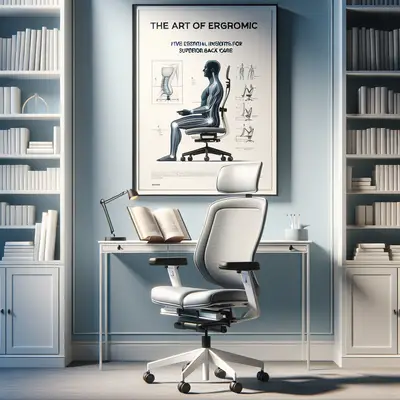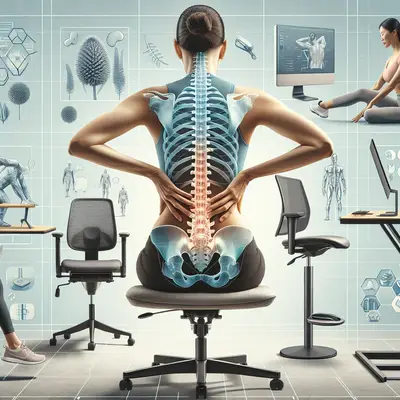
Back pain rarely announces itself with drama. It accumulates—minute by minute, chair by chair, email by email—until your spine becomes a ledger of unnoticed compromises. Modern ergonomics is not merely about chairs and keyboards; it is the artful calibration of your environment to honor the architecture of your spine. When done well, it feels less like “setup” and more like subtle luxury: a daily experience of being physically well-arranged.
This is ergonomics as quiet precision rather than gadgetry—an approach that privileges nuance, long-term refinement, and the kind of comfort that feels almost architectural in its stability.
Redefining “Neutral”: The Spine as a Dynamic Shape, Not a Frozen Pose
Many ergonomic guides speak of “neutral spine” as though it were a static position you should hold all day. In reality, the spine is designed for gentle, continuous micro-movements—tiny shifts that nourish discs, joints, and supporting muscles.
A refined approach to ergonomics acknowledges that:
- Neutral is a range, not a point. A healthy spine naturally has curves: cervical (neck) lordosis, thoracic kyphosis, and lumbar lordosis. Ergonomic support should preserve these curves, not flatten them.
- Stillness can become strain. Sitting in a technically “perfect” posture without movement eventually overloads tissues just as much as a visibly poor posture.
- Micro-adjustments are protective. Small shifts—subtle pelvic tilts, minor reclines, slight changes in leg position—reduce pressure on any one structure and promote blood flow.
- Your ideal angle may be slightly reclined. A modest recline (100–110 degrees) has been shown in research to reduce spinal disc pressure versus strict 90-degree sitting.
- The goal is sustainable ease. If your posture feels like effortful holding, it is not truly ergonomic; an elegant setup invites your body into alignment rather than demanding it.
For those with back issues, thinking of posture as a flexible “comfort band” rather than one rigid position can be liberating—and more protective over long days.
Insight 1: The “Four-Point Alignment” That Quietly Changes Everything
Most discussions of ergonomics focus on individual objects—the chair, the desk, the screen. A more sophisticated approach looks at how four critical points of your body relate to one another: feet, pelvis, ribcage, and head. When these are harmonized, many small discomforts resolve upstream.
Consider this four-point alignment as your discreet daily check-in:
- Feet: Both feet resting fully on a stable surface, hip-width apart, with weight evenly distributed—not tucked under the chair or dangling. If your feet do not reach the floor comfortably, a low footrest (even a sturdy box to start) is not a luxury item but a structural necessity.
- Pelvis: Seated so that the pelvis is slightly anteriorly tilted—imagine your beltline gently angled forward, not slumped backward. This encourages the lumbar curve without you having to “sit up straight” from the upper back.
- Ribcage: Stacked over the pelvis, not collapsing forward or flaring upward. The sensation should be of light vertical buoyancy, not stiffness—your lower ribs gently floating above your hips.
- Head: Aligned so that your ears are roughly over your shoulders—not reaching forward toward the screen. Often, this is solved not by “pulling the head back” but by raising the screen and bringing work closer so your neck doesn’t have to overreach.
Once these four points are in quiet conversation with each other, chair adjustments and lumbar supports become fine-tuning mechanisms rather than desperate compensations. For many with chronic back tension, this global alignment delivers more relief than endlessly swapping chairs.
Insight 2: The Distance Principle—How Far Away Things Are Matters More Than You Think
We often obsess over angles—of knees, of elbows, of recline—but neglect distances. Yet reach distance is one of the most underestimated drivers of back strain.
Subtle but impactful refinements include:
- Screen distance: For most people, the ideal distance is roughly an arm’s length, with the top of the screen just below eye level. If the screen is too far, the head creeps forward; too close, and the upper back tenses in micro-bracing.
- Keyboard and mouse proximity: They should be close enough that your upper arms remain relaxed by your sides, forearms hovering parallel to the floor or with a slight downward angle. If you must reach, your shoulder girdle and upper back quietly pay the price.
- Secondary items hierarchy: Objects you use constantly (phone, notebook, stylus) belong within a “primary reach zone”—reachable with elbows still near your torso. Infrequent-use items belong farther out. This prevents repeated twisting and reaching that accumulates over months.
- Vertical distance from eyes to work: Laptops placed flat on a desk force a downward gaze that compresses the neck and upper back. A simple stand or stack of books to elevate the screen, paired with an external keyboard, is often more curative than any posture lecture.
For sensitive backs, curating distances is an elegant way to reduce strain without feeling constrained. It transforms the workspace from a scattered surface into a carefully measured field that quietly protects your spine.
Insight 3: The “Postural Signature” of Your Day—and How to Counterbalance It
Most people have what might be called a postural signature: a repeated stance or seating style that dominates their day. For some, it’s the forward-leaning laptop hunch. For others, it’s the driver’s slouch or the one-sided shoulder bag. Sophisticated ergonomics doesn’t simply improve that primary position—it deliberately balances it.
To work intelligently with your postural signature:
- Identify your dominant pattern. Are you mostly flexed (bent forward), twisted to one side, looking down, or leaning? Even a quick reflection on your most common positions reveals a theme.
- Design counter-moments. If you spend hours in lumbar flexion (curled forward), give your spine regularly scheduled moments of extension: gentle standing backbends, chest-opening stretches, or reclining slightly in your chair with full back support.
- Use transitions as therapy. Each time you stand up (for water, a call, the door), pair it with a 10–20 second counter-position specific to your pattern. Over months, these micro-interventions accumulate as structural resilience.
- Subtle asymmetry correction. If your work favors one side (e.g., mouse use, phone cradling), consider ambidextrous habits—occasionally shifting the mouse to the other side or using a headset so both shoulders rest evenly.
This approach treats ergonomics as choreography rather than furniture. It assumes that your spine remembers patterns—and that the most refined care you can offer is not perfection, but intentional counterbalance.
Insight 4: Surfaces Speak—The Texture and Yield of Support Matter
Not all support is created equal. The surface quality of what you sit and lean against has a profound, often underappreciated impact on back comfort.
Key nuances to consider:
- Overly soft vs. properly supportive. Plush chairs may feel indulgent at first touch but often allow the pelvis to sink and roll backward, flattening the lumbar curve and stressing discs. A more refined chair or cushion offers gentle yield with clear underlying support—think “firm with grace,” not rigid.
- Segmented support zones. High-quality backrests often have built-in zones: more pronounced support in the lumbar region, slightly softer around the thoracic area. This mimics your actual spinal curves rather than treating your back as a flat panel.
- Seat depth and edge design. A seat that is too deep prevents your lower back from using the backrest, forcing you either to slump or to perch. Ideally, there should be a small gap (about 2–3 fingers) between the front edge of the seat and the back of your knees. A waterfall edge (sloped front) reduces pressure behind the thighs and encourages better circulation.
- Textile and temperature. Breathable fabrics reduce subtle muscular tension caused by heat and stickiness. For those prone to back pain, micro-discomfort from overheating can lead to constant fidgeting that never truly finds rest.
For individuals managing back issues, it is worth viewing your seating not as a commodity but as an interface: the place where your skeletal structure negotiates with your environment. The more intentionally this interface is chosen and adjusted, the calmer your back will feel at baseline.
Insight 5: Ergonomic Rituals—The Small Rehearsals That Make Comfort Automatic
The most elevated ergonomics are the ones you no longer have to think about. To reach that point, it helps to treat ergonomic refinement not as a one-time setup, but as a sequence of micro-rituals—brief, predictable actions that reset your relationship with your space.
Examples of refined ergonomic rituals include:
- Morning check-in (60–90 seconds): Before you open your inbox, adjust chair height so feet rest fully; confirm lumbar contact with the backrest; bring keyboard and mouse closer than you think you need; center the screen with your nose. Once a day is enough to prevent slow drift into misalignment.
- Hour markers as movement cues: Each time the clock reaches a new hour, stand and walk for one minute or perform 2–3 gentle spinal mobility movements. It’s a discreet pattern that builds in dynamic protection.
- Transition resets: After a long call or deep-focus work session, take 20–30 seconds to recalibrate your sitting position—pelvis, ribcage, head, and feet. The goal is not perfection, but preventing one compromised posture from becoming the default for the entire day.
- Evening “undoing”: As you step away from your workspace, a short ritual of spine-friendly movements (gentle cat-cow, supported child’s pose, or simply lying flat on the floor with knees bent) helps your nervous system and back tissue release the imprint of the day.
Over time, these rituals feel less like discipline and more like a form of personal curation—small gestures of respect for the structure that carries you through your work, your obligations, and your ambitions.
Conclusion
Ergonomics, at its most sophisticated, is not about surrounding yourself with expensive objects. It is about arranging your world so your spine is never asked to negotiate more than it must. From four-point alignment to considered reach distances, from postural counterbalances to intelligently chosen surfaces and daily rituals, each decision is a quiet vote for long-term spinal ease.
For those living with back issues, this approach offers something deeper than quick fixes: a subtle recalibration of how you inhabit your space. In that quiet geometry of comfort, productivity becomes less about endurance and more about effortless presence—your back supported not by willpower, but by design.
Sources
- [National Institute of Neurological Disorders and Stroke – Low Back Pain Fact Sheet](https://www.ninds.nih.gov/health-information/disorders/low-back-pain) – Overview of causes, risk factors, and management strategies for back pain
- [Mayo Clinic – Office Ergonomics: Your How-to Guide](https://www.mayoclinic.org/healthy-lifestyle/adult-health/in-depth/office-ergonomics/art-20046169) – Practical guidelines for setting up a workstation to reduce back and neck strain
- [Occupational Safety and Health Administration (OSHA) – Computer Workstations eTool](https://www.osha.gov/etools/computer-workstations) – Detailed recommendations on chair design, posture, and workstation arrangement
- [Harvard Health Publishing – The Right Way to Sit at Your Desk](https://www.health.harvard.edu/pain/the-right-way-to-sit-at-your-desk) – Evidence-informed tips on posture, positioning, and movement breaks
- [Cornell University Ergonomics Web – Ergonomic Guidelines for Arranging a Computer Workstation](http://ergo.human.cornell.edu/ergoguide.html) – In-depth research-based recommendations on distances, angles, and workstation configuration
Key Takeaway
The most important thing to remember from this article is that this information can change how you think about Ergonomics.