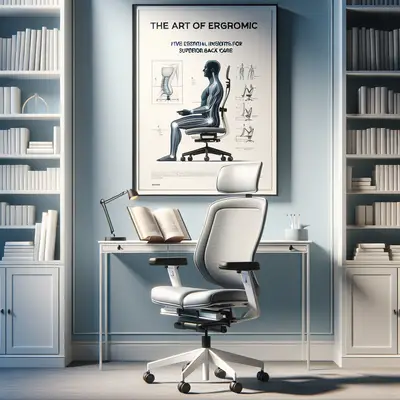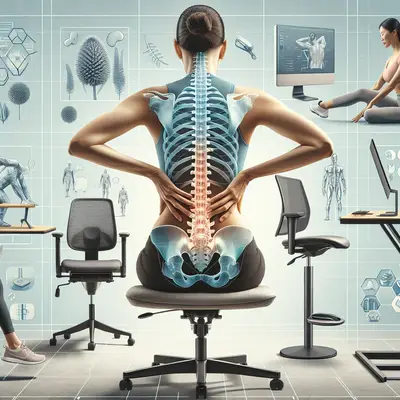
In a world that prizes endurance, the back is often expected to perform without complaint, bearing the quiet weight of our ambition. Only when discomfort sharpens into pain do most people begin to consider ergonomics—and even then, the conversation is usually reduced to chairs and cushions. For those who live with a demanding back, this is not nearly enough. True ergonomic refinement is less about acquiring objects and more about orchestrating how your body, environment, and attention interact over hours, days, and years. What follows is a sophisticated view of ergonomics, with five exclusive, under-discussed insights that speak to people who demand more than generic advice from their care practices.
Beyond the Chair: Designing a Whole-Body Ergonomic Ecosystem
Ergonomics is often reduced to a single purchase—a “good” chair, an imposing desk, an expensive standing setup. In reality, the back responds not to isolated products but to patterns: how you transition from task to task, room to room, and role to role. A refined ergonomic approach treats your environment as an ecosystem composed of micro-settings: where you read, how you think, where you type, how you rest, and even how you wait.
Rather than anchoring your entire day to one “perfect” station, consider curating a small constellation of thoughtfully arranged zones: a primary workstation optimized for focused tasks, a standing or leaning area for shorter bursts of work, a lounge configuration for reading or calls, and a floor-based setup for stretching or low-intensity laptop use. Each station can subtly shift the demands placed on your spine—changing hip angles, load distribution, and muscle recruitment—so no single structure (disc, joint, or muscle group) is asked to endure all day without relief. For an exacting back, the luxury is not one flawless setup, but a harmonious rotation of good ones.
Insight 1: Micro-Postures Matter More Than “Perfect Posture”
Conventional wisdom glorifies “perfect posture” as a static ideal: shoulders back, spine neutral, feet flat. In practice, this vision is both unrealistic and unhelpful, especially for those already managing back issues. The modern understanding of spine health suggests that dynamic variety—a series of micro-postures sustained briefly and then exchanged for others—is more protective than rigid stillness, even if that stillness looks “correct.”
Consider posture less as a fixed pose and more as a pattern of movement within a narrow, comfortable range. A refined approach acknowledges that you will lean, rotate, cross your legs, perch on the edge of your seat, shift to one side, and recline slightly. The key is to avoid letting any one of these positions dominate your entire work session. Building in intentional micro-adjustments every 10–20 minutes—subtle seat-depth shifts, small pelvic tilts, alternating which leg bears more weight, or minor changes in recline—re-distributes pressure through the discs and joints, encourages blood flow, and prevents specific tissues from shouldering the burden alone. For an already-sensitive back, this quiet choreography can feel less like correction and more like relief.
Insight 2: The “Angle of Thought” — How Cognitive Demand Shapes Your Spine
One of the most overlooked aspects of ergonomics is how mental intensity changes the way you hold your body. When you move from routine emails to high-stakes problem-solving, your muscles unconsciously brace, your breathing shallows, and your neck subtly migrates forward toward the screen. This “angle of thought” can be more predictive of your pain at day’s end than the quality of your chair.
Sophisticated back care acknowledges that ergonomics is as much cognitive as it is physical. For tasks that require focus and strategic thinking, your setup should anticipate tension: bring the screen up slightly higher, ensure the top of the monitor is at or just below eye level, use a separate keyboard to prevent neck craning toward a laptop, and keep documents at eye level when possible. Pair this with deliberate breathing intervals when you begin demanding work—five slow breaths in which you allow the shoulders to drop and the jaw to unclench. This coupling of mental intensity with ergonomic refinement prevents your brain from quietly pulling your spine into a defensive, compressive posture that feels sustainable in the moment but extracts a cost over time.
Insight 3: The Luxury of Load Management, Not Just Cushioning
Much of what is sold as “ergonomic” is essentially improved padding: thicker cushions, softer lumbar supports, more generous upholstery. While comfort has its place, back health is more directly influenced by how load is managed—how much force is transmitted through each region of the spine, how long it is maintained, and how it is shared across muscles and joints.
For those with persistent back issues, sophisticated ergonomics means thinking in terms of controlled load, not just softness. For seated work, this might mean using a chair that allows mild recline to offload the lumbar spine while still supporting the head and neck in a position that doesn’t encourage forward jutting. When standing, it may involve alternating between both feet and a small footrest to subtly change pelvic and lumbar mechanics, rather than simply standing perfectly still on a soft mat. At home, when reading or using a tablet, it might mean supporting your arms on pillows or armrests so that your upper back and neck are not constantly recruited to hold the device aloft. True ergonomic luxury lies in distributing effort intelligently, so no single structure is asked to perform beyond its capacity for longer than it can tolerate.
Insight 4: Temporal Ergonomics — Matching Setups to the Time of Day
Most ergonomic advice is spatial—where your chair goes, how high your desk sits, how far the screen should be. Yet the back also has a temporal rhythm: muscles fatigue at predictable times, discs hydrate and dehydrate across the day, and pain thresholds can shift with energy and mood. A sophisticated approach to ergonomics respects this timing and assigns tasks to times of day accordingly.
If your back tends to be stiffer in the morning, you might start with a reclining or more supported arrangement that allows gentler loading, gradually moving to more upright or standing work once your body has warmed. For individuals whose pain spikes in the late afternoon, reserving the most demanding postures (such as prolonged standing or unsupported sitting) for earlier hours and planning gentler tasks later can reduce flare-ups. Short, recurring “reset windows” of two to three minutes—light walking, gentle spinal decompression by hanging from a sturdy bar or doorframe (if medically appropriate), or lying briefly on the floor with legs elevated—can be scheduled at consistent intervals rather than left to chance. Treating time itself as an ergonomic variable transforms your day from a passive accumulation of strain into a curated sequence of tolerable, even supportive, demands on your back.
Insight 5: Atmosphere as Anatomy — How Light, Sound, and Temperature Affect Your Spine
Atmosphere may seem like a luxury detail, but for those with recurring back issues, it can be an influential part of ergonomic design. Harsh lighting, visual clutter, noise, and poorly regulated temperature don’t just disturb concentration; they subtly change your nervous system’s baseline. When your system is chronically “on alert,” muscles hold more tension, pain signals can be amplified, and your threshold for tolerating normal postural loads shrinks.
Refined ergonomics therefore includes visual and sensory minimalism. Gentle, indirect lighting reduces squinting and forward head posture. A well-positioned task light allows you to bring the work closer without bending toward it. Soundscapes—quiet, controlled, or intentionally soothing—can reduce sympathetic activation, easing muscle guarding in the neck and lower back. Temperature also matters: being slightly cold can encourage hunching and bracing, while slightly warmer environments tend to favor softening of muscle tone, though excessive heat may increase fatigue. Treating your surroundings as an extension of your anatomy, rather than simple decoration, allows you to create an environment that quietly advocates for your back throughout the day.
Conclusion
For an exacting back, generic ergonomic advice is not enough, and a single “correct” setup is a myth best retired. The back thrives under conditions of informed variety, precise load management, and thoughtful attention to both the mind and the environment it inhabits. Micro-postures replace rigid ideals; high-focus tasks are cushioned by high-quality support; time is curated so that demand and capacity remain in dialogue; and atmosphere becomes part of the therapeutic plan rather than an afterthought.
Sophisticated ergonomics is not about perfection—it is about designing a life in which your spine is no longer an afterthought, but a quiet partner in everything you do. For those already living with back challenges, this shift from products to patterns, from objects to orchestration, is where true comfort and resilience begin.
Sources
- [National Institute for Occupational Safety and Health (NIOSH): Ergonomics and Musculoskeletal Disorders](https://www.cdc.gov/niosh/topics/ergonomics/default.html) - Overview of ergonomic principles, risk factors, and workplace strategies
- [Mayo Clinic – Office Ergonomics: Your How-To Guide](https://www.mayoclinic.org/healthy-lifestyle/adult-health/in-depth/office-ergonomics/art-20045769) - Practical guidance on setting up an ergonomic workspace, including chair, desk, and monitor positioning
- [NIH / MedlinePlus – Back Pain](https://medlineplus.gov/backpain.html) - Evidence-based information on causes, prevention, and management of back pain
- [Harvard Health Publishing – Proper Posture for a Healthy Back](https://www.health.harvard.edu/pain/proper-posture-for-a-healthy-back) - Discussion of posture, spinal alignment, and how small changes in daily habits affect back health
- [Cleveland Clinic – Ergonomics: How to Make Your Workspace Comfortable and Healthy](https://health.clevelandclinic.org/ergonomics-at-work) - Detailed breakdown of ergonomic adjustments for sitting, standing, and device use
Key Takeaway
The most important thing to remember from this article is that this information can change how you think about Ergonomics.