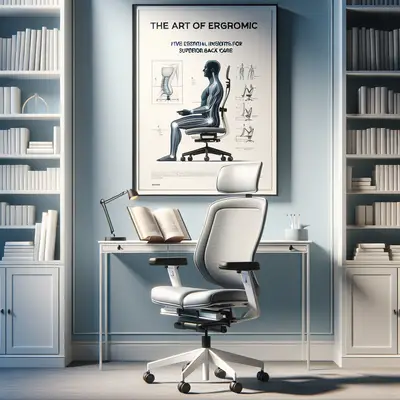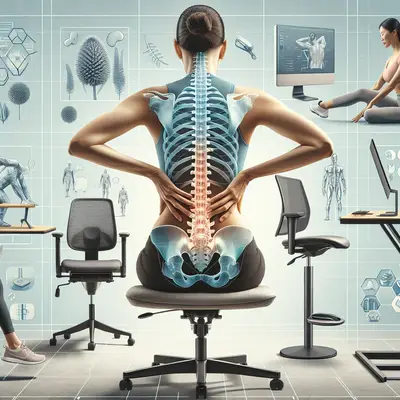
Back pain rarely arrives with fanfare. It appears quietly—in the pause before standing, the subtle hesitation before bending, the weary shift in your chair at 3 p.m. Ergonomics, at its highest expression, is not about gadgets or trend-driven chairs; it is the quiet, precise calibration of your environment to the way your body is actually built to move. For those already living with back issues, this is not a matter of comfort alone—it's a question of how gracefully you can move through your day, and how much strain you demand from an already burdened spine.
Below are five exclusive insights that look beyond generic advice, and instead invite a more discerning, intelligent approach to ergonomic back care.
Insight 1: Design Your Day Around Your Spine’s Natural Rhythm
Most ergonomic advice starts with furniture; a more refined approach starts with time.
Your spine does not tolerate load in the same way at all hours. After waking, your intervertebral discs are slightly more hydrated and plump, meaning bending and twisting under heavy load can place more pressure on spinal structures. For those with back issues, early-morning deep flexion—like lifting laundry baskets or aggressively stretching hamstrings—can quietly amplify discomfort later in the day. A more considered rhythm involves reserving higher-load tasks (lifting, housework, gym sessions) for mid-to-late morning or early afternoon, when tissues have warmed and adapted to movement.
At work, the same principle applies. Rather than eight static hours at a “perfect” desk, think in 60–90 minute modules. Alternate between high-focus seated work, lighter standing tasks, brief movement breaks, and, where possible, walking calls or reading away from the screen. Ergonomic excellence is far less about a single ideal posture and far more about a thoughtful choreography of postures over time.
Insight 2: Treat the Chair as an Instrument, Not a Throne
A premium chair is not a guarantee of a calm back; it is merely an instrument waiting to be tuned.
For people with back issues, the nuanced settings of a chair—often ignored—can make the difference between quiet stability and slow aggravation. Seat depth, for example, is more than a spec sheet number: if the seat pan is too long, you will slide forward or lose contact with the backrest, forcing your lumbar spine to hold you upright unsupported. Too short, and your weight concentrates through a smaller surface, increasing pressure.
Backrest angle, lumbar support height, and tilt tension are equally critical. Some spines prefer a subtly reclined posture of 100–110 degrees, which reduces disc pressure compared to the classic 90-degree seated angle. Others, especially those with certain disc or facet joint issues, may feel better with more upright support and less flexion. The refinement lies in intentional micro-adjustments over several days—adjusting one parameter at a time, observing how your back feels not just immediately, but by evening and the following morning. Ergonomics becomes a process of listening to your spine and adjusting the “instrument” until it supports you with minimal effort.
Insight 3: Elevate Micro-Movements to a Daily Therapeutic Ritual
For an irritated back, grand gestures of exercise may be less powerful than subtle, frequent micro-movements woven into the day.
Static loading—the act of holding almost any position for too long—is a quiet antagonist to spinal comfort. Even technically “good” posture becomes problematic when it is rigid. Micro-movements counter this by gently shifting load, nourishing joint surfaces, and prompting low-level muscular activity without triggering a flare-up. Think of gentle pelvic tilts while seated, slow weight shifts when standing, or unobtrusive ankle and hip movements that invite the spine to respond.
An elegant strategy is to anchor micro-movements to specific cues: each email sent, every time you end a phone call, or every change in document or task. Over time, your workday becomes laced with small calibrations—subtle extensions, minor rotations within comfortable range, brief standing intervals—that help your back feel “attended to” rather than ignored. For many with chronic back issues, these minor, frequent adjustments create more meaningful change than a single intense workout trying to “fix” the day’s stiffness.
Insight 4: Curate Your Visual Field to Protect Your Spine
Visual ergonomics is often treated as an eye-care concern, yet your eyes quietly dictate the posture of your entire upper body.
When your screen is too low, your gaze drops, your head follows, and your cervical and thoracic spine gradually fold forward, encouraging a long day of flexion. For a spine already under duress, this cascading effect can increase muscle tension between the shoulder blades and encourage compensatory lumbar postures. Raise the monitor so the top third of the screen is near eye level, and your neck and upper back are invited into a more neutral, elongated position.
Equally important is visual distance and clarity. If you are constantly leaning forward to read text or peer at small details, no chair or desk height will fully rescue your posture. A refined approach includes appropriate screen distance (often about an arm’s length), adequate font size, and, where needed, task-specific eyewear prescribed for computer distance rather than generic “reading glasses.” When your visual field is thoughtfully curated, your spine can settle into its work rather than strain around your screen.
Insight 5: Engineer Transitions, Not Just Workstations
Ergonomics does not end at the edge of your desk. For many people with back issues, the most provocative moments of the day are transitions—standing after prolonged sitting, getting in and out of the car, bending to put on shoes, or lifting a bag from the floor.
These are the moments where a vulnerable back is often caught unprepared, shifting quickly from static to dynamic. A more sophisticated approach designs these transitions as carefully as the workstation itself. Before standing from a chair, for instance, perform a brief, subtle spinal reset: place your feet firmly, hinge slightly from the hips rather than rounding the back, lightly engage the abdominal wall, and use both legs evenly to rise. When entering or exiting a car, pivot the entire body as a unit—hips and shoulders together—rather than twisting through the lumbar spine while the pelvis stays anchored.
At home, store frequently used items between mid-thigh and shoulder height to reduce repetitive deep bending. For items that must be lifted from the floor, position your feet around the object, hinge at the hips, and keep the load close to your body. These are small, almost invisible refinements—but for a sensitized spine, they can be the difference between quietly getting through the day or provoking a lingering flare.
Conclusion
Ergonomics, at its most cultivated level, is not a checklist of generic rules. It is a bespoke dialogue between your body and your environment, refined over time. For those living with back issues, this dialogue becomes even more important: your spine is already speaking; the question is whether your surroundings are listening.
By honoring your spine’s daily rhythm, treating your chair as a finely tuned instrument, integrating micro-movements, curating your visual field, and engineering the often-overlooked transitions of the day, you move beyond quick fixes and into a more intelligent, enduring practice of back care. The result is not just less pain, but a quieter, more composed relationship with your own body—one where comfort is not an indulgence, but a thoughtfully designed standard.
Sources
- [National Institute of Neurological Disorders and Stroke – Low Back Pain Fact Sheet](https://www.ninds.nih.gov/health-information/disorders/low-back-pain) – Overview of causes, risk factors, and approaches to managing low back pain
- [Mayo Clinic – Office Ergonomics: Your How-To Guide](https://www.mayoclinic.org/healthy-lifestyle/adult-health/in-depth/office-ergonomics/art-20046169) – Practical, evidence-informed guidance on workstation setup and posture
- [Cleveland Clinic – Ergonomics: How to Make Your Workspace Comfortable and Efficient](https://health.clevelandclinic.org/workplace-ergonomics) – Detailed discussion of workplace ergonomics and strategies to reduce musculoskeletal strain
- [Occupational Safety and Health Administration (OSHA) – Computer Workstations eTool](https://www.osha.gov/etools/computer-workstations) – U.S. government resource on ergonomic principles for computer-based work
- [Harvard Health Publishing – Why Good Posture Matters](https://www.health.harvard.edu/pain/why-good-posture-matters) – Explores the relationship between posture, muscle balance, and back discomfort
Key Takeaway
The most important thing to remember from this article is that this information can change how you think about Ergonomics.