Back comfort is rarely transformed by grand gestures. It changes, almost imperceptibly, through quiet decisions embedded in the way you sit, stand, work, and even pause. Ergonomics, at its most refined, is less about gadgets and more about how your environment choreographs your spine’s daily experience. For those living with back issues, subtle ergonomic intelligence can mean the difference between a tolerable day and a draining one.
This is not a guide to buying a new chair. It is an invitation to rethink how your space, your posture, and your habits collaborate—often unconsciously—to shape the health of your back.
Ergonomics as a Daily “Ambient Setting,” Not a Single Setup
We often treat ergonomics as a static solution: arrange the desk, adjust the chair, position the monitor—and assume the work is done. In reality, your back experiences ergonomics as a continuous, evolving “ambient setting” across your entire day, not a single workstation.
From the car seat that quietly rounds your shoulders, to the sofa that subtly pulls your pelvis into a slouch, your spine encounters a sequence of micro-environments. Each one either supports or undermines recovery. For people with back issues, the goal is not one perfect posture, but a consistent standard of “reasonable support” in every context you use often: desk, dining table, commute, lounge, and even bedside reading.
This means curating a small ecosystem of supports—seat wedges, portable lumbar rolls, a laptop riser, a travel footrest—that you can redeploy across settings. When thought of this way, ergonomics shifts from a one-time project to a quiet design principle that follows you through your day.
Exclusive Insight #1:
Treat ergonomics as a lifestyle setting rather than a single workstation fix. Evaluate the five places you sit most often and bring each to a baseline level of spine support, instead of perfecting just your desk.
Designing Your “Neutral Spine Corridor”
You may know the idea of a “neutral spine,” but for many, it stays abstract. In practice, one of the most sophisticated ergonomic moves is to design what could be called your neutral spine corridor—a narrow, comfortable range of alignment that you can return to effortlessly throughout the day.
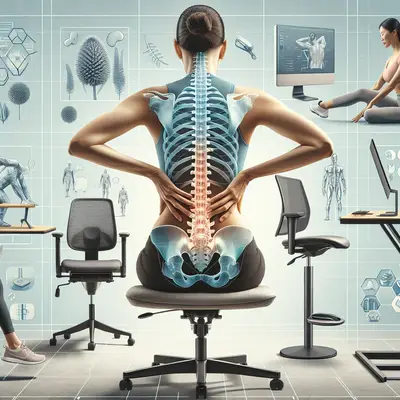
Imagine your spine as a column with three key curves: cervical (neck), thoracic (mid-back), and lumbar (lower back). The goal is not military rigidity, but a gentle preservation of these curves while you sit, stand, and lean. Instead of chasing a single “perfect” posture, you create a corridor—a forgiving spectrum between “upright enough” and “relaxed but supported.”
Ergonomically, this corridor is supported by:
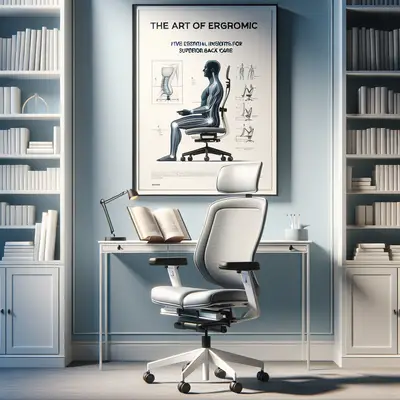
- A seat height that allows your feet to rest fully on the floor (or a footrest)
- Hips positioned very slightly above knee level to reduce lumbar strain
- Lumbar support that meets the natural inward curve of your lower back—not above it, not below it
- A monitor at or just below eye level to prevent forward head drift
For those with back pain, your task is to make that neutral corridor so easy and natural that it becomes your default, not your effortful correction.
Exclusive Insight #2:
Instead of policing your posture, engineer your environment so that your “neutral spine corridor” is the path of least resistance—your chair, desk, and screen should make good alignment feel like the most relaxed option, not the most disciplined.
Mapping Micro-Strain: The Missing Ergonomic Assessment
People commonly ask whether their chair, mattress, or keyboard is causing their pain. The more revealing question is: Where are you accumulating micro-strain without noticing? Back pain often results not from one dramatic error, but from small, repeated stresses that never get fully dissipated.
A sophisticated ergonomic approach involves performing a personal micro-strain audit:
- Notice the position you drift into after 20–30 minutes of concentrated work. That is your true posture.
- Pay attention to subtle warning signs: a need to fidget constantly, pressure points under the thighs, a single shoulder working harder for the mouse, repeated head-forward lean to see the screen.
- Observe transitions: how you move from sitting to standing, lifting bags, loading the dishwasher, or twisting to pick something off the floor. Many backs are injured not in the primary task, but in the careless transition.
Micro-strain mapping reveals the specific patterns that keep your back on edge: perhaps you always lean on one elbow, cross the same leg, or perch on the front of the seat. Once seen, these patterns can be gently redesigned.
Exclusive Insight #3:
Conduct a three-day “micro-strain audit.” Every time you shift due to discomfort, briefly note what position you were in and what you were doing. After a few days, adjust your environment to target the two or three most common stress patterns you discover.
Intelligent Movement Intervals: When and How You Interrupt Stillness
Most ergonomic advice focuses on how you sit, but for backs that are already sensitized, how long you stay in any position may matter more than how ideal that position appears. Even an excellent chair cannot neutralize the effects of prolonged stillness.
Instead of relying on generic “take a break every hour” rules, consider intelligent movement intervals tailored to your back’s actual tolerance. The first step is to notice the time window before your discomfort escalates—perhaps it’s 25 minutes of focused sitting, or 40 minutes standing at a counter. Set your reminders for 10–15 minutes before that threshold, not after.
These breaks don’t need to be elaborate. Often, the most therapeutic intervals are understated: standing to take a call, shifting to a different chair for laptop work, doing three slow pelvic tilts, or walking the length of your home or office. The priority is variation—altering what your spine, hips, and shoulders are being asked to do.
Over time, this approach respects both your body’s limits and its adaptability, teaching your back that movement is safe, predictable, and non-threatening.
Exclusive Insight #4:
Calibrate movement breaks to precede, not follow, discomfort. Identify your personal time-to-discomfort window for sitting and standing, then schedule changes in position 10–15 minutes before that point as a non-negotiable ergonomics habit.
Curating a Personal “Support Palette” for Flare-Up Days
On good days, your back may tolerate imperfect setups with minimal protest. On flare-up days, tiny ergonomic missteps can feel magnified. A refined approach to back care includes a personal support palette: a small, well-chosen set of items and adjustments reserved for vulnerable periods.
This might include:
- A slightly firmer, higher chair or cushion for days when getting up is difficult
- A portable lumbar roll you can use in the car, at work, or on the sofa
- A laptop stand to raise the screen when you must work from less-than-ideal locations
- A footrest or low stool to subtly adjust pelvic tilt and relieve lower back pressure
- A secondary “light-duty” workstation (such as a standing surface or a reclined reading setup) for when traditional sitting is intolerable
The elegance lies not in owning every ergonomic device, but in knowing exactly which two or three supports make the greatest difference for your back and having them readily accessible. This transforms flare-up days from chaotic improvisation into a rehearsed, reassuring routine.
Exclusive Insight #5:
Assemble a dedicated flare-up kit—two or three portable supports and one alternative work setup that you deploy only when symptoms rise. Knowing you have a pre-planned ergonomic response can reduce both physical strain and the anxiety that often amplifies back pain.
Conclusion
Ergonomics, at its most elevated, is not an aesthetic of sleek chairs or imposing desks. It is the quiet refinement of how you move through space, how your spine is greeted by each surface, and how your day alternates between support and freedom.
For those living with back issues, small ergonomic decisions accumulate into something profound: a back that is less frequently provoked, a body that feels more thoughtfully accommodated, and a daily life that is no longer organized around pain, but around intelligent comfort.
Your task is not to pursue perfection, but to cultivate a discerning relationship with your environment—one that makes the healthy choice the natural one, and transforms back care from an emergency intervention into a subtle, ongoing art.
Sources
- [National Institute of Neurological Disorders and Stroke – Low Back Pain Fact Sheet](https://www.ninds.nih.gov/health-information/disorders/low-back-pain) – Overview of causes, risk factors, and approaches to managing low back pain
- [Mayo Clinic – Back pain: Symptoms and causes](https://www.mayoclinic.org/diseases-conditions/back-pain/symptoms-causes/syc-20369906) – General background on back pain and contributing lifestyle factors
- [Occupational Safety and Health Administration (OSHA) – Computer Workstations eTool](https://www.osha.gov/etools/computer-workstations) – Evidence-based ergonomic recommendations for workstation design and posture
- [Cornell University Ergonomics Web – Ergonomic Guidelines for Arranging a Computer Workstation](http://ergo.human.cornell.edu/ergoguide.html) – Detailed guidance on optimal positioning of chairs, monitors, keyboards, and accessories
- [Harvard Health Publishing – The right way to sit at your desk](https://www.health.harvard.edu/pain/the-right-way-to-sit-at-your-desk) – Practical, research-informed advice on sitting posture and movement throughout the workday
Key Takeaway
The most important thing to remember from this article is that this information can change how you think about Ergonomics.