Back pain rarely arrives with drama. It creeps in quietly—through a slightly twisted posture at your desk, a laptop perched a little too low, a shoulder bag loaded “just for today.” For those who value performance, presence, and longevity, ergonomics is not about gimmicky chairs or trendy devices; it is about cultivating an environment so well considered that your spine can almost forget it exists.
This is ergonomics as refinement: deliberate, intelligent choices that allow your back to work less, so you can do more—without the constant negotiation with discomfort. Below, you’ll find five exclusive, often-overlooked insights designed for people who have already tried the obvious fixes and are ready for a more elevated approach.
Beyond the Chair: Curating a Spine-Friendly Visual Field
Most ergonomic advice stops at “sit up straight,” yet your spine is consistently responding to what your eyes are doing. Visual ergonomics—how your screens, documents, and lighting are arranged—quietly dictates the posture you hold for hours at a time.
Begin with your primary screen. The top of the display should be at or slightly below eye level, with the center of the screen roughly 15–20 degrees below your natural gaze. This subtle downward angle encourages a neutral neck position instead of the forward jut that compresses the cervical spine. If you work from a laptop, elevating it with a stand and using an external keyboard and mouse is not an indulgence; it is structural protection.
Lighting matters just as much. Glare or dim light prompts you to lean forward, squint, and crane your neck. A softly diffused, front-angled light source reduces eye strain so your body doesn’t unconsciously inch toward the screen. And for those working across multiple monitors, align them so that your primary tasks are directly in front of you, not 30 degrees to one side. This seemingly trivial adjustment can significantly reduce rotational stress through the neck and upper back over a long workday.
When you refine what your eyes see, your spine quietly follows.
The Micro-Posture Concept: Subtle Adjustments, All Day Long
One of the more sophisticated truths of ergonomics is that “perfect posture” is not a position—it’s a rhythm. The spine prefers variety over rigidity. Micro-postures are the small, almost invisible shifts you make within a generally aligned position, preventing your back from being locked into one configuration for too long.
Think of sitting not as a single pose but as a family of acceptable positions within a healthy range. Slightly adjust how much you lean into the backrest, change the angle of your hips by a few degrees, or gently rotate your pelvis forward and back while maintaining a neutral curve. These incremental shifts keep joints nourished, muscles oxygenated, and nerves unconstrained.
Refined ergonomics means designing your setup to invite these micro-adjustments rather than discourage them. A chair with a responsive backrest, a height-adjustable desk, or a footrest that allows you to change leg positions helps you move without disrupting your workflow. Even small rituals—a subtle shoulder roll while a page loads, a gentle neck reset when a call ends—can interrupt the static patterns that aggravate back pain.
The goal is not to be still; it is to be quietly, continuously self-correcting.
The Load Signature: How Your Daily Objects Shape Your Spine
Your spine “reads” every object you carry or handle and adapts to its weight, shape, and frequency. This is your load signature—the unique pattern of mechanical stress created by how you move through your day. Those with back issues benefit from treating this as something to be designed, not endured.
Start by examining the items you use most: your bag, laptop, phone, water bottle, even the books or files you transport. A heavy shoulder bag worn on the same side each day encourages lateral spinal bending and asymmetric muscle loading, particularly through the lumbar area. Upgrading to a structured backpack with two straps is not merely a convenience; it’s an architectural decision for your body.
Pay attention to asymmetries at your workstation. Is your phone always on one side, prompting constant twisting? Are key documents placed just out of reach so you lean and flex repeatedly in the same direction? Subtle changes—centralizing frequently accessed objects, placing heavier items closer, and using document holders—can reduce cumulative stress.
Consider weight distribution at home as well. Lifting groceries from the floor, carrying laundry baskets at arm’s length, or routinely lifting a child from the same side all contribute to your load signature. A more refined approach involves bringing items closer to your center of gravity, bending at the hips and knees while keeping the spine elongated, and alternating sides whenever possible.
Over time, a thoughtfully managed load signature can mean fewer inflammatory flares and greater day-to-day ease.
Quiet Core Support: Using the Seat and Surface to Your Advantage
Core strength is often framed as something you “earn” in the gym, but ergonomics allows you to borrow support from your environment. The elegance lies in arranging your seat, backrest, and work surface so that your core works with you rather than against constant imbalance.
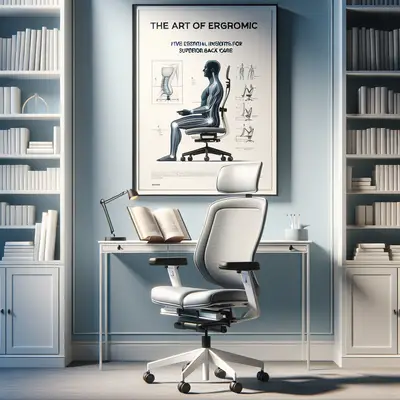
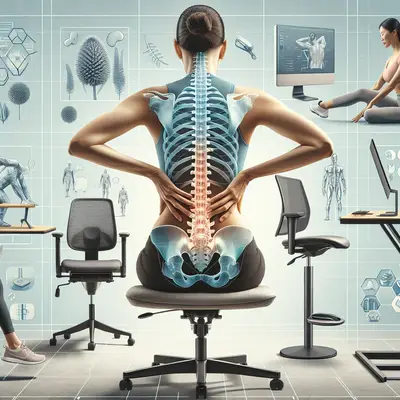
Begin with the pelvis: it is the foundation of your seated spine. Adjust your chair height so that your hips are at least level with, and ideally slightly higher than, your knees. This alignment lets your pelvis tilt gently forward, enabling the natural lumbar curve instead of collapsing into a C-shape that strains the lower back. A well-placed lumbar support—either built-in or added—should meet the small of your back, not push it aggressively forward.
Your desk height should allow your forearms to rest parallel to the floor, elbows near 90 degrees, shoulders relaxed and not climbing toward your ears. If your desk is too high, you subtly shrug all day; too low, and you hunch. Both patterns place additional load on the thoracic spine and the muscles that attempt to stabilize it.
A footrest (or a stable object used as one) is a quiet but powerful tool. By giving your feet a firm, supportive base, you reduce tension throughout the posterior chain, from calves to hamstrings to lower back. This transforms sitting from a precarious balancing act to a grounded posture, where the core can gently brace instead of constantly rescue.
In this way, your surroundings become a silent exoskeleton, minimizing the effort your back must expend to keep you upright.
Ergonomic Rituals: Designing Elegant Breaks That Actually Restore
Most people know they “should take breaks,” yet they stand, check their phone, refill a drink, and return to the same posture that created the problem. A sophisticated ergonomic strategy treats breaks as active recalibration—moments that measurably improve spinal comfort and function.
Begin by pairing breaks with existing anchors in your day: before a meeting, after sending a major email, or each time you change tasks. During these brief interludes—often 60 to 120 seconds is enough—prioritize three quiet reset elements: decompression, circulation, and re-orientation.
Decompression might be as simple as standing tall and gently reaching overhead, allowing the spine to lengthen, or placing your hands lightly on a counter and easing your hips back to create a mild traction effect. Circulation can be encouraged by walking a short loop, raising and lowering your heels, or performing a few controlled sit-to-stands from your chair, all while maintaining a long, neutral spine.
Re-orientation means consciously re-assembling your posture before you sit back down: feel your sit bones connect with the seat, align your ears over your shoulders, and bring your screen back to the correct height if it has drifted. This intentional sequence transforms a cursory “stretch break” into a subtle but effective maintenance ritual for your back.
Over time, these micro-rituals build a kind of postural literacy—an instinctive sense of when your spine is aligned, supported, and ready for sustained concentration.
Conclusion
Ergonomics, at its highest level, is not a catalog of products but a philosophy of respect—for your spine, your nervous system, and your long-term capacity to perform at a high level. By refining your visual field, embracing micro-postures, designing your load signature, harnessing quiet core support, and elevating your break rituals, you transform everyday environments into active collaborators in your back’s well-being.
For those already acquainted with back pain, these details are not luxuries; they are leverage. With deliberate, elegant adjustments, you can reduce the background noise of discomfort and reclaim a body that feels composed, responsive, and quietly powerful throughout the day.
Sources
- National Institute of Neurological Disorders and Stroke – Low Back Pain Fact Sheet – Overview of causes, risk factors, and management of low back pain
- Occupational Safety and Health Administration (OSHA) – Computer Workstations eTool – Evidence-based guidance on optimal workstation setup and posture
- Mayo Clinic – Office Ergonomics: Your How-To Guide – Practical recommendations for chair, desk, and equipment adjustments
- Harvard Health Publishing – Proper Lifting Techniques – Guidance on safe lifting and load management to protect the back
- National Institute for Occupational Safety and Health (NIOSH) – Ergonomics and Musculoskeletal Disorders – Research-based insights into ergonomic risk factors and preventive strategies
Key Takeaway
The most important thing to remember from this article is that this information can change how you think about Ergonomics.