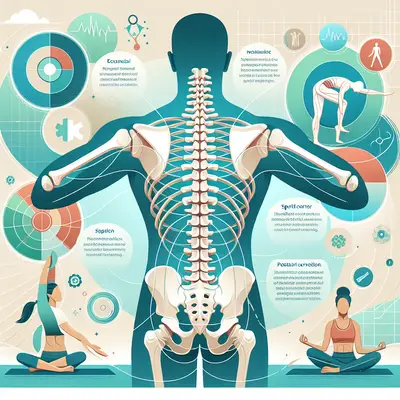
Back health is often reduced to generic advice: “sit up straight,” “strengthen your core,” “lift with your legs.” For those who expect more from their bodies—and from their healthcare—such clichés feel inadequate. The spine is not simply a column to be “fixed,” but a dynamic, highly responsive system shaped quietly by what you do, how you recover, and even how you think throughout the day. This article explores five exclusive, often-overlooked insights that elevate back care from basic maintenance to a more cultivated, strategic practice.
Insight 1: Your Spine Responds to Micro-Stability, Not Just Big Movements
Most people think of back health in terms of large, obvious motions—heavy lifts, gym sessions, yoga flows. Yet the spine’s resilience is profoundly influenced by “micro-stability”: the subtle, continuous adjustments your deep stabilizing muscles make as you sit, stand, and move.
These deep stabilizers—such as the multifidus and transverse abdominis—don’t announce themselves with dramatic exertion. They work quietly in the background, fine-tuning each shift of weight and each rotation of your torso. When these muscles are undertrained or inhibited by prolonged sitting, pain is more likely to be triggered by minor, everyday tasks than by heroic athletic efforts.
Practices that enhance micro-stability are often small and deceptively simple: controlled pelvic tilts while seated, slow standing weight shifts, or mindful transitions from sitting to standing. These micro-movements teach the spine to distribute load evenly and restore the reflexive support that protects discs, joints, and ligaments. When viewed through this lens, back care becomes less about a single “big workout” and more about the sophistication of how your body manages everyday forces all day long.
Insight 2: The Way You “Land” From Stillness Matters as Much as How You Sit
Most ergonomic conversations fixate on the static posture: the perfect chair height, lumbar support, monitor alignment. But what often provokes pain is not the posture itself—it is how you exit it. The transition from stillness to motion is when the spine is most vulnerable, especially after long periods in one position.
After sitting for an hour, the discs in your lower back have absorbed fluid and are temporarily more sensitive to bending and twisting. Standing up abruptly, twisting to reach a bag, or leaning forward to grab a laptop can create a sudden, uneven load on a spine that is not yet “reawakened.” The same principle applies when getting out of bed, stepping out of a car, or rising from a lounge chair.
A refined back-care habit is to build deliberate “landing rituals” as you leave stillness. Before standing, gently rock your pelvis, engage your lower abdominals, and subtly press your feet into the floor. When you first stand, pause, align your ribcage over your pelvis, and then walk rather than twist and reach. These transitional moments, repeated dozens of times a day, can quietly reduce strain and prevent “mysterious” episodes of pain that seem to appear from nowhere.
Insight 3: How You Breathe May Be Quietly Dictating Your Back Pain
Breathing is often discussed in terms of stress, sleep, or athletic performance—rarely as a primary architect of spinal health. Yet the diaphragm, the principal muscle of respiration, also shares intimate anatomical and functional connections with the lumbar spine and deep core.
Shallow, upper-chest breathing reduces the diaphragm’s movement, encouraging overuse of secondary breathing muscles in the neck and upper back. Over time, this pattern can stiffen the thoracic spine and ribs, forcing the lower back to compensate with excessive motion. In contrast, well-coordinated diaphragmatic breathing supports intra-abdominal pressure, which acts like an internal “air cushion” that gently stabilizes the spine from within.
A sophisticated back-care approach treats breath as structural, not just emotional. Practicing slow, nasal, diaphragmatic breathing—where your lower ribs widen softly in all directions—can improve trunk stability, reduce unnecessary tension, and support more efficient movement patterns. When breath, spine, and deep core fire in concert, the back is not merely supported; it is orchestrated.
Insight 4: Your Spine Interprets Stress as Load—Even When You’re Still
Modern imaging and pain research has revealed a nuanced truth: the severity of back pain does not always correlate with the severity of structural changes on MRI. Stress, sleep, mood, and prior pain experiences influence how the nervous system interprets and amplifies pain signals. For the spine, stress is just another form of load—one that rarely gets discussed during physical exams.
High-demand lifestyles often normalize tension: late nights, compressed schedules, constant digital connectivity. The body responds with subtle but persistent muscle guarding, altered movement patterns, and reduced capacity to recover from otherwise manageable physical demands. Over time, this creates a background of heightened sensitivity, where small mechanical irritations are felt as disproportionately intense pain.
Elevated back care acknowledges that nervous system load is inseparable from mechanical load. This does not trivialize structural issues; rather, it recognizes that a spine under psychological strain has less bandwidth to tolerate physical strain. Practices that deliberately downshift the nervous system—consistent sleep, brief “off-duty” windows without screens, or even structured relaxation sessions—are not indulgences. They are intelligent load-management strategies that allow the back to heal and perform more reliably.
Insight 5: Recovery Quality Often Outweighs Exercise Quantity
It is tempting to believe that more exercise automatically equals a healthier back: more stretches, more strengthening, more mobility drills. Yet, especially for those with recurrent or long-standing pain, the differentiator is often not the volume of effort but the precision of recovery.
Spinal tissues—discs, facet joints, ligaments, and muscles—respond best to a cycle of measured stress followed by adequate restoration. When workloads increase but recovery does not keep pace, micro-irritations accumulate below the level of conscious awareness. The result is a sudden “flare-up” that seems unrelated to any specific event.
Premium back care respects recovery as a structured, active process. This might include: segmenting demanding tasks throughout the week instead of clustering them into one “marathon” day; deliberately scheduling low-load movement days after heavier activity; and incorporating gentle decompression practices like supported supine rest with legs elevated. Sleep quality, hydration, and anti-inflammatory nutrition further shape how effectively the spine rebuilds after stress. In refined practice, you do not just ask, “What did I do today?” but also, “What did I give my spine to recover from what I did today?”
Conclusion
Elevated back care is not about mastering a single perfect posture or memorizing a catalogue of exercises. It is about cultivating a more discerning relationship with your spine—how it stabilizes in micro-moments, how it transitions out of stillness, how it collaborates with your breath, how it responds to stress, and how it recovers from every demand you place upon it.
For those who expect their backs to carry them through ambitious, demanding lives, these understated shifts offer a more intelligent path forward. When you begin to treat your spine not merely as a structure to be “fixed,” but as a responsive partner to be understood and supported, back care evolves from a chore into a quiet, enduring advantage.
Sources
- National Institute of Neurological Disorders and Stroke – Low Back Pain Fact Sheet – Overview of causes, risk factors, and modern understanding of low back pain
- Harvard Health Publishing – The Truth About Back Pain – Explores the relationship between imaging findings, lifestyle, and back pain perception
- Mayo Clinic – Back Pain: Symptoms and Causes – Detailed discussion of mechanical, structural, and lifestyle contributors to back pain
- Cleveland Clinic – Core Strength and Back Pain – Explains the role of deep core and stabilizing muscles in supporting the spine
- NIH – The Role of Psychosocial Factors in Back Pain – Research-based insight into how stress, mood, and cognitive factors influence back pain and recovery
Key Takeaway
The most important thing to remember from this article is that this information can change how you think about Back Health.