Back care is often reduced to quick fixes and generic advice. Yet for those who quietly demand more—from their bodies and their environments—there is a more refined path: one built on subtle adjustments, intelligent routine design, and a deeper understanding of how the spine responds to daily life.
What follows is not a catalogue of clichés, but five exclusive, often-overlooked insights for people who are serious about elevating their back health beyond the ordinary.
1. The Micro-Rest Philosophy: How You Pause Matters More Than How Long
We instinctively think recovery requires long breaks—weekends off, extended vacations, full rest days. For the spine, however, it’s the texture and frequency of rest that matters more than duration.
Micro-rests are brief, intentional interruptions in spinal loading—typically 20–60 seconds—woven throughout your day. This is not idling at your desk or scrolling your phone; it is conscious decompression. Standing up and letting your arms hang, taking a slow diaphragmatic breath, gently shifting weight from one foot to the other, or briefly lying flat on the floor with knees bent: these micro-interludes recalibrate your spinal discs and surrounding muscles.
Spinal discs are hydrophilic structures; they absorb and release fluid in response to loading and unloading. Extended static positions—whether sitting or standing—tip this balance toward fatigue and irritation. Micro-rests restore the natural rhythm of loading and recovery, reducing the cumulative strain that often presents as a “mysterious” ache by late afternoon.
For those with demanding schedules, this philosophy reframes back care as something you layer into your day, not something you must carve out separate time for. The spine does not need your weekend; it needs 45 strategic seconds, repeated with quiet discipline.
2. The Breathing Ledger: How Your Ribcage Quietly Governs Your Lower Back
Most people treat breathing as background noise, irrelevant to back health. But the ribcage is effectively the upper architecture of the spine, and the way you breathe can either stabilize or subtly disturb this structure all day long.
Shallow, upper-chest breathing invites tension into the neck and upper back, and undermines the natural support of the diaphragm. When the diaphragm is underused, the lower back and smaller stabilizing muscles are recruited to “help” with what should be a simple job—breathing. Over time, this creates a quiet tax on the lumbar spine.
Deliberate, diaphragm-led breathing does the opposite: it gently mobilizes the thoracic spine, allows the ribs to move expansively, and provides internal pressure that supports the lumbar segments from within. Imagine your breath widening your lower ribs, your abdomen expanding subtly in all directions, and your spine floating inside this pressurized, stable cylinder.
A simple refinement: while seated, place one hand on your upper chest and one on your lower ribs. Inhale so the lower hand feels more movement than the upper. Exhale slowly, as if fogging a mirror. This is not a relaxation gimmick; it is a structural upgrade, one breath at a time.
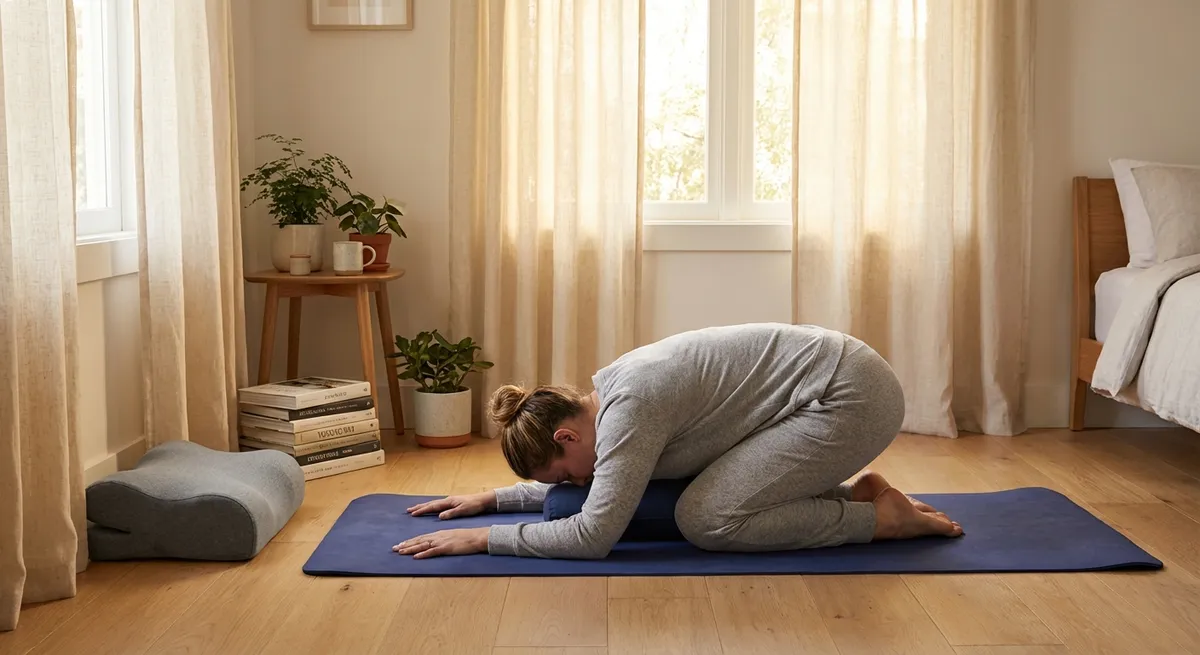
3. The Evening Reset: Designing a Spine-Friendly Descent Into Rest
Most people obsess over their morning routine and neglect the hours when the spine transitions from the demands of the day into the stillness of sleep. Yet evening is when many subtle spinal stresses either resolve—or quietly accumulate.
An elegant evening reset has three components: decompression, down-regulation, and deliberate positioning.
Decompression might mean spending two to three minutes lying on your back on a firm surface with a small towel under your head and knees bent, allowing your spine to lengthen without effort. Down-regulation is the intentional lowering of your nervous system’s intensity—soft lighting, slower breathing, and avoiding contorted positions on the sofa that your spine will “pay for” overnight.
Deliberate positioning is the final act: choosing a sleep posture that respects your spine rather than simply indulging habit. For most, side-lying with a pillow between the knees and a pillow height that keeps the neck in line with the rest of the spine offers an elegant balance of support and comfort. For back sleepers, a pillow under the knees can subtly ease lumbar extension.
When practiced consistently, the evening reset turns sleep into active recovery, not merely unconscious time passing.
4. The Weight of Small Things: How Tiny Loads Shape Your Spine Over Time
We often scrutinize big loads—heavy suitcases, gym weights, major lifting at work—while ignoring the small, repetitive loads that shape our spine’s daily reality. Yet it’s the understated burdens—your shoulder bag, your laptop, your handbag, your child on one hip—that frequently contribute to asymmetric loading and long-term discomfort.
The spine thrives on variety and symmetry. Constantly carrying a bag on the same side, cradling your phone between ear and shoulder, or always shifting weight onto one leg while standing creates an ongoing pattern that the body must constantly compensate for. These micro-asymmetries may feel innocuous but often explain why pain appears to be “sudden” when, in reality, it has been quietly cultivated.
Refinement here is not about avoiding all carrying; it’s about elevating the way you do it. Distribute loads between both sides, alternate shoulders, favor backpacks over single-strap bags for heavier items, and periodically transfer what you carry in your hands to your other side. Instead of defaulting to the most convenient habit, treat each carry as a subtle opportunity to protect balance along your spine.
Luxury in back care is not always about specialized equipment; it often begins with the way you handle what you already own.
5. The Precision of “Enough”: Rethinking Exercise for a Demanding Back
Exercise is frequently prescribed as an all-purpose solution for back health—but dosage, intensity, and precision matter as much as the choice of exercise itself. Too little, and the spine deconditions. Too much, or poorly structured, and it becomes another irritant in an already overloaded system.
The concept of “enough” is central here: enough movement to keep muscles responsive and supportive, but not so much aggressive loading that the spine never has space to recalibrate. The goal is not heroic effort; it is intelligent, repeatable effort.
For those managing back issues, refined exercise often means:
- Prioritizing control over performance: slower, more precise movements rather than explosive ones.
- Focusing on endurance of deep stabilizers (like the multifidus and transverse abdominis) rather than just the strength of large superficial muscles.
- Integrating movements that coordinate the hips and thoracic spine with the lumbar spine, instead of isolating any one region in an artificial way.
- Respecting the “day after test”: if an activity constantly leaves your back feeling worse 24 hours later, it needs redesign—not blind persistence.
Elite athletes and high-performers increasingly work with this level of nuance, not because they are fragile, but because they understand that longevity is the highest form of performance. For anyone with a demanding life, the spine deserves this same standard of precision.
Conclusion
Exceptional back care rarely announces itself with dramatic gestures. It is found in the 45-second pause between tasks, the texture of a single breath, the way you place your body into sleep, the side you choose to carry your briefcase, the amount of effort you decide is enough.
When you begin to treat these details not as trivialities but as investments, the spine responds. Comfort becomes less of a coincidence and more of a cultivated state—quiet, deliberate, and remarkably sustainable.
Sources
- National Institute of Neurological Disorders and Stroke – Low Back Pain Fact Sheet - Overview of causes, risk factors, and management principles for low back pain
- Mayo Clinic – Back Pain Basics - General information on back pain causes, prevention, and when to seek care
- Harvard Health Publishing – Why Good Posture Matters - Explores how posture, daily habits, and spinal alignment influence back health
- Cleveland Clinic – Diaphragmatic Breathing - Details the technique and benefits of diaphragm-led breathing for stability and relaxation
- National Library of Medicine (NIH) – Exercise Therapy for Chronic Low Back Pain - Research review on how specific exercise approaches affect chronic low back pain outcomes
Key Takeaway
The most important thing to remember from this article is that this information can change how you think about Back Health.