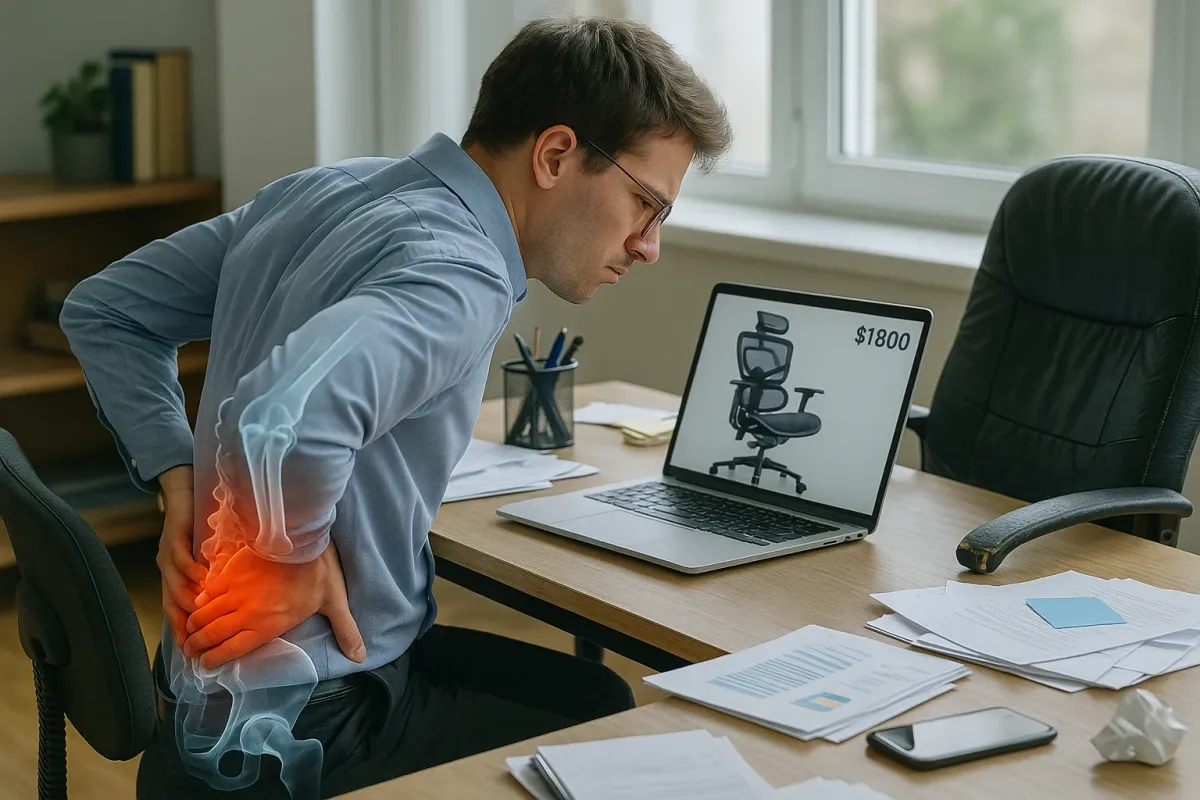
The internet is still buzzing over the story of the $1,800 Herman Miller Aeron chair that kept mysteriously “walking away” from a new employee’s cubicle—until the chair thief was confronted and ultimately arrested. Beyond the drama, that viral headline taps into a deeper truth: our backs are paying the price for long hours in chairs that cost far less than our laptops, yet quietly shape our health every single day.
As Cyber Monday and extended online sales flood our feeds with “ergonomic” deals, it has never been more timely to ask: does an expensive chair actually protect your spine, or is it only part of the story? For those who expect more than generic advice—and who see their back health as a long-term, premium investment—exercise therapy is the discreet, powerful counterpart to even the most advanced seating technology.
Below, we explore five refined, exercise-therapy–driven insights inspired by today’s office-chair obsession—so your spine becomes the true luxury item, not just your furniture.
The Aeron Effect: Why a Chair Alone Cannot Save Your Spine
The Herman Miller Aeron has become a status symbol in tech and corporate circles—its presence in the recent viral workplace story only reinforced its aura of exclusivity. Its engineering is impressive: adjustable lumbar support, breathable mesh, and precision-tuned tilt mechanics. Yet even the most meticulously designed chair cannot neutralize the biological reality of prolonged sitting: muscles weaken, joints stiffen, and circulation slows.
Exercise therapy reframes the chair as a tool, not a solution. The spine is not a static column to be “held” in place but a dynamic structure supported by a living corset of muscles and fascia. Without regular movement input—especially targeted, intelligent strengthening and mobility—the body slowly molds to the chair’s shape and your work habits, not the other way around. An elite office setup without a deliberate movement strategy is like owning a grand piano and never learning to play: impressive to look at, quietly wasted in function.
Micro-Sessions, Major Dividends: The New Luxury is Movement Frequency
The modern Cyber Monday narrative promotes bigger, smarter, more expensive purchases—a standing desk here, a gaming chair there—as if equipment could erase years of sedentary behavior. Exercise therapy, in contrast, is exquisitely minimalist: it prizes frequency and quality of movement over elaborate gear.
For back care, the most refined approach is not a one-hour workout performed heroically three times a week, but 60–90 seconds of precise movement every 45–60 minutes. Think of these as “micro-interventions” that reset your spinal mechanics before discomfort escalates:
- A slow, controlled standing back extension, hands on hips, gently opening the front of the body.
- Seated pelvic tilts, rolling the pelvis forward and back to mobilize the lumbar spine.
- Elegant cervical glides—drawing the head gently backward over the shoulders—to counter forward-head posture.
This approach creates a steady drip of therapeutic input throughout the day. For discerning professionals accustomed to premium experiences, this is the true luxury: a spine that feels refreshed at 4 p.m., not just at 9 a.m.
Precision Strength: Curating a “Muscular Endowment” for Your Spine
The $1.8K chair saga underscored a quiet truth: people will fight for comfort. But the most sophisticated comfort is not plush; it is supported. Exercise therapy pursues a specific goal—creating a resilient “muscular endowment” around your spine that renders you less dependent on external support.
Instead of generic core workouts, refined back care targets:
- Deep abdominal stabilizers (especially the transversus abdominis) to act as an internal weight belt.
- Multifidus and spinal extensors along the vertebral column to maintain upright posture without constant effort.
- Gluteal power to offload the lower back during standing, walking, and lifting.
- Scapular stabilizers to anchor the upper back and prevent the shoulders from collapsing forward.
This is the difference between feeling “propped up” by a chair and feeling inherently supported by your own musculature. The most advanced ergonomic design becomes exponentially more effective when it meets a body that is already strong, balanced, and well-coordinated.
Posture as a Moving Target: Retiring the Myth of the “Perfect Chair Position”
As workplaces upgrade to designer chairs and height-adjustable desks—often spurred by trending stories of high-end office equipment—many are still searching for the elusive “perfect posture.” Exercise therapy offers a more elegant, flexible paradigm: there is no single ideal position; there is only the next position.
Static postures, even textbook ones, eventually become stressful for tissues. The spine thrives on variety: small shifts in angle, subtle rotations, alternations between sitting, standing, and walking. The refined strategy is to orchestrate a seamless choreography of postures over the course of the day:
- Begin seated with a slightly reclined, well-supported lumbar curve.
- Transition to a perched, more upright position as focus intensifies.
- Shift to standing for calls or virtual meetings, allowing the hips to open.
- Interleave short walks or stretch sequences between deep work blocks.
Exercise therapy informs this choreography by revealing where your body is restricted, where it is overworking, and which movements restore equilibrium fastest. Instead of obsessing over the perfect chair settings, you become a connoisseur of posture transitions—knowing precisely when and how to adjust.
Beyond the Chair: Designing a Personal “Spinal Portfolio” for Daily Life
The Cyber Monday culture of deals and upgrades tempts us to look for one defining purchase—a chair, a device, a wearable—that will “fix” our back. The reality is more nuanced and, ultimately, more empowering: your back responds to an entire ecosystem of behaviors, not one hero product.
An elevated exercise-therapy–guided “spinal portfolio” might include:
- A curated morning sequence of 6–8 minutes: gentle spinal mobility, hip opening, and deep core activation before the first email is opened.
- Structured desk intervals, where each work block is paired with one specific micro-exercise tailored to your key vulnerabilities (for example, thoracic extension over a rolled towel for those who hunch, or hip flexor releases for habitual sitters).
- Evening decompression rituals, such as supported child’s pose, supine twists, or controlled diaphragmatic breathing to calm the nervous system and soften protective muscle tension.
- Weekly “audit sessions” with a skilled physical therapist or exercise specialist, in-person or virtually, to refine your program as your body adapts.
In this framework, the chair—Aeron or otherwise—becomes a single, thoughtfully chosen instrument in a well-orchestrated ensemble. The focus shifts from acquisition to integration: how every element of your environment and behavior participates in the ongoing care of your spine.
Conclusion
The viral saga of the $1.8K office chair illuminated more than workplace etiquette; it highlighted how fiercely we chase comfort in environments that quietly erode our backs. Yet the most sophisticated response is not to merely secure a better seat, but to elevate the way we inhabit it.
Exercise therapy offers a premium, evidence-informed approach that transcends furniture trends. By cultivating micro-movements, precision strength, posture fluidity, and an intentional spinal portfolio, you transform your back from something that must be constantly protected into something that is quietly, reliably strong.
In a world captivated by flash sales and flagship chairs, the most enduring upgrade is not what you sit on—it is how exquisitely your body is prepared to sit, stand, move, and live.
Key Takeaway
The most important thing to remember from this article is that this information can change how you think about Exercise Therapy.