A refined life is rarely accidental. It is composed—gesture by gesture, choice by choice—even in the way you sit to send an email or lean in to read a screen. For those living with back issues, ergonomics is not a peripheral concern; it is the invisible architecture that determines whether your day unfolds with quiet composure or mounting discomfort. This is not about buying the most expensive chair in the room. It is about learning to orchestrate your environment so your spine is not asked to suffer for your ambitions.
Below are five exclusive, often-overlooked ergonomic insights that speak to people who demand more from their bodies, their spaces, and their lives.
1. Treat Your Chair as a Tailored Garment, Not a Generic Seat
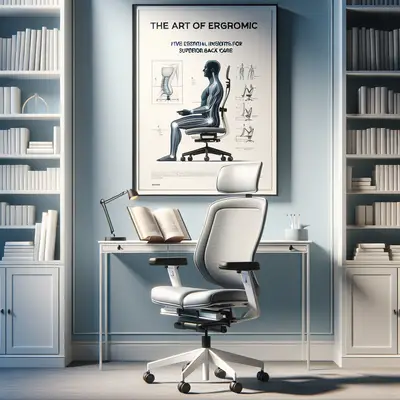
The chair you occupy for hours each day should fit you as precisely as a well-cut jacket. Yet most people simply sit on a chair, rather than in it.
Begin with the seat height. Your hips should rest slightly higher than your knees, allowing a dignified, open angle at the hips that encourages a natural lumbar curve. If your feet do not rest fully on the floor when you achieve this, do not lower the chair—elevate the floor with a footrest or a discreet platform. This preserves spinal alignment without compromising lower-limb support.
Next, consider seat depth. You should be able to slide two to three fingers between the edge of the seat and the back of your knees. Too deep, and you unconsciously slide forward, collapsing your lower back; too shallow, and your thighs are under-supported, creating subtle strain. Adjust the backrest or add a slim, high-density cushion to achieve that refined fit.
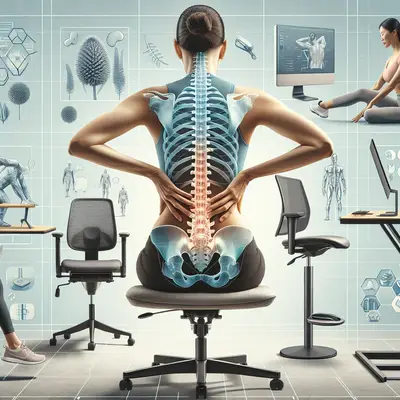
Finally, the backrest should meet your spine, not chase it. Adjust lumbar support so it aligns with the natural inward curve of your lower back, not the middle of your ribcage. If your chair lacks this precision, a small, firm lumbar roll—used intentionally rather than as a decorative accessory—can convert an ordinary chair into a more civilized support system.
2. Design a Visual Horizon That Respects Your Neck
For many with back pain, the true saboteur lives a few inches above the spine: the neck. Your cervical posture is radically shaped by where your eyes are invited to gaze.
Your primary screen should meet your gaze, not demand an apology from your posture. The top of the screen should be at or slightly below eye level, with the center of the screen a gentle downward glance away. If you work on a laptop, this means the device cannot remain both keyboard and screen—elevate the screen with a stand and commit to using an external keyboard and mouse.
Thoughtfully control viewing distance. An ideal range for most people is roughly an arm’s length away. Too close and you crane forward; too far and you strain or squint, pulling head and neck out of alignment. If you use multiple screens, designate one as primary and place it directly in front of you; secondary screens should be angled slightly, not positioned so far to the side that your day becomes a series of minor, repetitive twists.
Lighting belongs in this conversation as well. Glare forces subtle but relentless adjustments—tilting the head, leaning closer, hunching. Use blinds, diffused task lighting, and matte screen filters where necessary, so that your neck and upper back are not constantly negotiating with the sun or overhead lights. A considered visual horizon reduces the quiet, cumulative tension that often masquerades as “mysterious” neck and upper-back pain.
3. Curate Micro-Movements Instead of Waiting for a Workout
Those with back issues are often diligent about scheduled exercise yet overlook the power of the in-between. Ergonomics is not a static ideal; it is a choreography of micro-movements that keep the spine from stiffening into discomfort.
Begin with a simple rule: no posture deserves more than 30–40 minutes of uninterrupted loyalty. Set subtle reminders—silent alarms, watch haptics, or ambient cue apps—that prompt a recalibration: uncross your legs, re-center your pelvis, lengthen your spine, rest your shoulders.
Introduce elegant micro-rituals. When you reach for your coffee, allow it to be an opportunity to glide your shoulder blades slightly back and down. When you turn to speak to someone, rotate with your entire torso instead of twisting through your lower back alone. While standing during a call, shift your weight from one foot to the other with deliberate control rather than idle fidgeting.
Consider a sit-stand desk as a tool of variation, not a moral upgrade from sitting. Alternate positions thoughtfully—perhaps 20–30 minutes standing followed by 45–60 minutes sitting—rather than grandstanding in a permanent stand. For a back that has already voiced its concerns, moderation, rhythm, and refinement are more therapeutic than extremes.
4. Align Your Hands to Protect Your Spine by Proxy
Back pain rarely exists in isolation. The way your hands meet your tools—the keyboard, the mouse, the phone—reverberates up the kinetic chain to your shoulders, neck, and ultimately your spine.
Your keyboard should lie flat or with a slight negative tilt (front edge higher than the back), allowing your wrists to remain neutral rather than cocked upward. A floating, relaxed hand position is preferable to one that is braced against a hard edge; if your desk cuts into your forearms, add a soft, low-profile desk pad.
Position your mouse so your elbow remains near your side, not abducted outwards. If you find yourself reaching, pull the mouse closer and perhaps narrower. For some, a compact keyboard (without a numeric keypad) creates space to bring the mouse into a more natural alignment.
Your shoulder girdle should feel quietly grounded, not subtly suspended. If you notice your shoulders creeping toward your ears during focused tasks, your desk may be too high—or your chair too low. Adjust so your elbows rest at approximately a 90–100-degree angle, forearms gently sloping downward to meet your input devices. This seemingly minor refinement can dramatically reduce upper-back and neck fatigue, particularly for those already sensitized by chronic discomfort.
5. Extend Ergonomics Beyond the Desk: The Private Spaces That Matter Most
Many people with back issues curate their workstations meticulously but neglect the other places where their spine quietly spends hours: the car, the sofa, the dining table, the bed. A truly elevated approach to ergonomics is whole-life, not workstation-only.
In the car, adjust your seat so your hips are level with or slightly above your knees, and your backrest reclines only modestly—about 100–110 degrees. If your lower back feels unsupported, add a small lumbar cushion rather than over-reclining. Bring the steering wheel closer and slightly higher so your shoulders remain relaxed rather than reaching forward.
At home, be discerning with soft seating. Deep, plush sofas that swallow you may look luxurious but often demand that your spine surrender its natural curves. If you prefer a low or soft sofa, use a firm cushion behind your lower back and consider a small footstool to prevent slumping. Choose reading positions that allow your head to remain aligned with your spine—propped up comfortably, rather than twisted or half-turned.
In the bedroom, evaluate your mattress not on trendiness but on response: it should be firm enough to support spinal alignment while allowing your shoulders and hips to nest subtly. Side sleepers with back concerns often benefit from a pillow between the knees; back sleepers may appreciate a slim pillow beneath the knees to ease lumbar tension. Here, ergonomics becomes intimate—supporting your spine in its most vulnerable, unguarded hours.
Conclusion
Elevated ergonomics is not about perfectionism; it is about stewardship. For those living with back issues, each detail—chair height, screen level, hand position, even the curve of your spine as you sit on the sofa in the evening—either honors or undermines your recovery.
When you begin to treat your environment as an extension of your spine’s well-being, every space becomes an ally rather than an adversary. The result is not just less pain, but more capacity: for focus, for poise, and for a daily life that feels as considered on the inside as it appears on the outside.
Sources
- National Institute of Neurological Disorders and Stroke – Low Back Pain Fact Sheet - Overview of causes, risk factors, and management strategies for low back pain
- Occupational Safety and Health Administration (OSHA) – Computer Workstations eTool - Detailed guidance on ergonomic setup for chairs, monitors, keyboards, and accessories
- Mayo Clinic – Office ergonomics: Your how-to guide - Practical recommendations on creating a healthier workstation and minimizing strain
- Cleveland Clinic – Ergonomics: How to Make Your Workspace Comfortable and Healthy - Clinically informed tips on posture, desk design, and movement throughout the day
- Harvard Health Publishing – Is your work chair actually hurting your back? - Discussion of how seating and postural habits influence back pain and what to adjust
Key Takeaway
The most important thing to remember from this article is that this information can change how you think about Ergonomics.