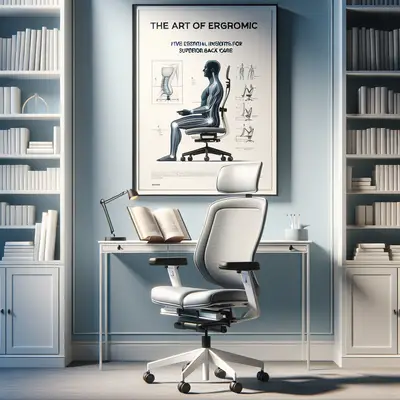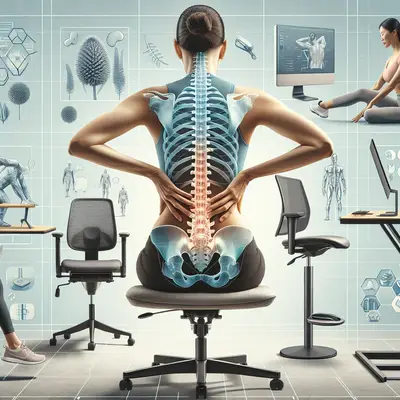
Our backs are often the quiet cost of ambition. We refine our wardrobes, our homes, our calendars—yet the spaces where we sit, think, and strive are frequently an afterthought. Ergonomics, when approached thoughtfully, is not about gimmicky chairs or novelty gadgets; it is about curating a daily environment that preserves the spine as carefully as we protect our time and attention. For those already living with back issues, that refinement is not a luxury—it is a form of necessary, dignified care.
Below, you’ll find five exclusive, nuanced ergonomic insights designed for people who are serious about both their work and their back health. These are not quick fixes, but cultivated practices that quietly reshape how your body experiences every hour at a desk, counter, or workstation.
Insight 1: Elevation as Strategy — Training Your Environment, Not Your Spine
Most ergonomic advice asks your body to fit a static setup. A more sophisticated approach flips that assumption: you train your environment to respond to you, instead of training your spine to endure.
Begin with one principle: your work surface should rise to meet your neutral posture, not the other way around. In practice, this means:
- Your forearms should rest parallel to the floor, with your elbows just open (slightly greater than 90 degrees), shoulders relaxed and heavy, not held.
- Your gaze should fall naturally to the top third of your screen without any forward head reach.
- Your hips should be level with or slightly above your knees, allowing your pelvis to sit in a neutral, untucked position.
Rather than purchasing a single “perfect” chair or desk, consider modular adaptability: a height-adjustable desk, a monitor arm with fluid movement, and a footrest that can be repositioned in seconds. The goal is an environment that can be recalibrated whenever your back needs change—flare-ups, fatigue, or recovery phases—without requiring you to brace and compensate.
For those already dealing with chronic back issues, this adaptable elevation is more than comfort; it is load management. You are continually redistributing mechanical stress across different joints and tissues instead of allowing one vulnerable area—often the lumbar spine—to absorb the full burden of every workday.
Insight 2: Micro-Alignment — The Art of Refining the 2% That Matters
Most people look for dramatic ergonomic changes: new chairs, new desks, new devices. Yet for back care, micro-alignment—the subtle 2% adjustments—is often where the most meaningful gains live.
Consider these refined, almost invisible corrections:
- Sliding your hips 1–2 inches deeper into the back of the chair to anchor the pelvis, instead of perching on the edge.
- Raising your screen by just a few centimeters to bring your neck into a more neutral alignment, minimizing the slow, persistent strain on the upper back.
- Gently widening your base of support—feet flat, about hip-width apart—to reduce tension in the low back and hips.
- Slightly tilting the backrest (100–110 degrees) rather than sitting bolt upright at 90 degrees, allowing the spine to share load with the backrest.
These adjustments seem inconsequential in the moment, but chronic back pain is often the sum of thousands of inconspicuous compromises. Micro-alignment is the daily discipline of removing those compromises, one small friction point at a time.
When your back is already sensitized, micro-movements are far more tolerable than dramatic posture shifts. They allow your nervous system to accept new positions without triggering protective tension or pain escalation—a subtle but powerful form of nervous-system negotiation.
Insight 3: The Ergonomic Day, Not the Ergonomic Chair
Ergonomics is often reduced to the object—“the right chair,” “the right keyboard.” A more elevated perspective considers the ergonomic shape of your entire day, not just the furniture that fills it.
Think of your day in ergonomic “chapters”:
- Deep-focus sessions: Perhaps you sit more supported, slightly reclined, with lumbar support engaged and feet grounded.
- Creative or collaborative work: You might stand at a raised desk, shifting weight between feet, occasionally resting one foot on a low support to reduce lumbar strain.
- Admin or low-demand tasks: This may be the perfect time for a more dynamic stool or perch seat that invites micro-movements of the pelvis.
By mapping your tasks to complementary positions, you prevent any single posture—no matter how “correct”—from becoming oppressive. For those with existing back issues, the question is not “What is the ideal position?” but “How often can I change position without losing focus?” The answer is usually: more often than you think.
Scheduling transitions (for example, a 30–45 minute sitting block followed by 10–15 minutes standing or walking) turns ergonomics into a pattern, not just a purchase. You are designing rhythm, which is often the missing layer in conventional ergonomic advice.
Insight 4: The Underrated Power of Contact Points
One of the most overlooked elements of refined ergonomics is the quality of your contact points—the subtle places where your body meets your environment: backrest, seat pan, armrests, desk edge, floor.
For a back already vulnerable to pain, poorly considered contact points can amplify discomfort in stealthy ways:
- A seat that is too deep forces you to slide forward, disconnecting the spine from the backrest and overloading the low back.
- Hard or intrusive armrests can cause you to elevate your shoulders to avoid pressure, feeding upper back and neck pain.
- A sharp desk edge can make you hover your forearms or brace your upper body, leading to tension that eventually radiates into the spine.
- Feet that cannot fully rest on a firm, stable surface often translate load upward, encouraging slumping or pelvic tilt.
Refined ergonomics asks: Is each contact point supportive, neutral, or irritating? Then it eliminates irritants with intention:
- Add a thin, stable lumbar pillow only if it supports natural curve—not to force an exaggerated arch.
- Adjust armrests so your shoulders can truly drop, or remove them if they repeatedly cause subtle shoulder lift.
- Use a footrest not as an accessory, but as a structural element that gives the pelvis permission to relax.
When your contact points are curated instead of accidental, the spine can finally stop bracing. This often reveals how much effort you were pouring into simply “getting through” a workday.
Insight 5: Precision Breaks — How You Pause Matters as Much as How You Sit
Most of us think of breaks as binary: working or not working. For someone with back issues, this is an oversimplification. A pause that continues to overload the same structures—leaning over a phone, standing locked at the knees, slumping on a soft couch—can be almost as taxing as the task you just left.
Consider precision breaks: brief, intentional interludes that actively reverse the specific stresses you’ve just placed on your back.
Examples include:
- After prolonged sitting, standing and gently lengthening through the front of the hips while keeping the ribs soft and not flared.
- After extended standing, sitting briefly with the back fully supported and the feet elevated on a low stool to gently ease lumbar compression.
- After intense screen work, walking for two to five minutes with relaxed arms, unhurried breathing, and a slightly longer stride to restore natural spinal rotation.
These are not workouts; they are architectural resets. Many people with chronic back pain discover that it is not necessarily the total number of hours they work that aggravates their condition—it is the uninterrupted sameness of their posture.
By designing breaks that are corrective rather than aimless, ergonomics becomes active care, not passive endurance. Over days and weeks, this can shift your back from perpetually recovering to quietly maintaining.
Conclusion
Elevated ergonomics is less about chasing the ultimate chair and more about cultivating a daily environment that respects the spine’s architecture and your body’s history. For those managing back issues, subtlety and adaptability matter more than dramatic interventions.
Train your environment to rise to you. Refine the small angles and contact points that shape how your back feels by mid-afternoon. Treat your day as a sequence of postures rather than a single fixed position. And allow your breaks to be precise, not accidental.
In doing so, ergonomics evolves from a checklist to a quiet form of preservation—one that honors both your work and the spine that makes it possible.
Sources
- National Institute of Neurological Disorders and Stroke – Low Back Pain Fact Sheet - Overview of causes, risk factors, and management strategies for low back pain
- Occupational Safety and Health Administration (OSHA) – Computer Workstations eTool - Detailed guidance on setting up ergonomic computer workstations
- Mayo Clinic – Office Ergonomics: Your How-To Guide - Practical recommendations for desk, chair, and monitor configuration
- Harvard Health Publishing – Proper Posture for a Healthy Back - Discussion of posture, spinal alignment, and back pain prevention
- Centers for Disease Control and Prevention (CDC) – Ergonomics and Musculoskeletal Disorders - Evidence-based insights into workplace ergonomics and musculoskeletal health
Key Takeaway
The most important thing to remember from this article is that this information can change how you think about Ergonomics.