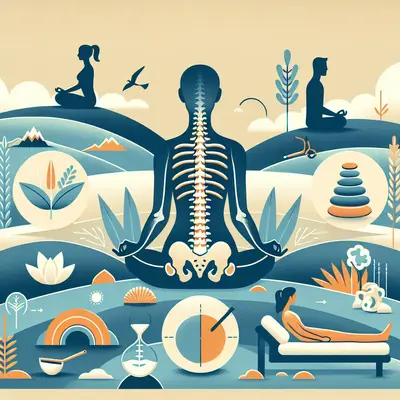
Back health rarely demands attention—until it does. For many, it shifts overnight from background support to the defining texture of each day: how you choose a chair, how you travel, even how you socialize. Amid the noise of quick fixes and generic advice, a more refined approach is possible: one that treats your spine not as a problem to be handled, but as a structure to be curated with discernment and precision. The following insights are designed for those who value nuance, subtle gains, and long-term excellence in how their back feels and performs.
Insight 1: Treat Your Spine as a Dynamic System, Not a Static Structure
Most people think of the spine as a column—upright, rigid, something to hold “straight.” In reality, it is a living, adaptive system that constantly negotiates forces from your muscles, your breath, your habits, and your environment. Each vertebra participates in a conversation with the discs, ligaments, and deep stabilizing muscles that subtly guide how you move through space.
Rather than aiming for a single, “perfect” posture, the refined goal is controlled variability. Sitting in one elegant position for hours is still mechanical stress by another name. A sophisticated approach values fluid micro-adjustments: a slight shift in weight, a deliberate change in leg position, a slow recalibration of how your ribcage stacks over your pelvis. Micro-movements throughout the day distribute load more intelligently than any one ideal pose.
Start noticing how often you freeze in one shape—at your desk, on the sofa, in the car. Then, instead of “fixing” your posture, invite small, intentional repositioning every 15–20 minutes. Over time, this transforms the spine from a passive structure to a responsive system, training subtle strength and resilience instead of dependency on rigid alignment rules.
Insight 2: Precision Breathing as a Hidden Back Support Strategy
For many, breathing is an afterthought—automatic, unquestioned. Yet the diaphragm, deep core musculature, and spinal stabilizers function as a quiet, integrated unit. When you breathe shallowly into only your upper chest, the delicate collaboration between these structures is compromised. When you breathe with depth and control, you create a natural, internal support for your spine that requires no gadgets and very little time.
Refined back care prioritizes diaphragmatic breathing not as a relaxation technique alone, but as structural hygiene. Feel your breath expand gently into the lower ribs, the sides of the waist, even into the back of the torso. On exhale, allow a subtle engagement of the deep abdominal layers—more like zipping up a fine garment than bracing for impact. This quiet interplay helps modulate spinal load, reduce muscular overcompensation, and refine your sense of where your body is in space.
Integrating this practice need not be performative. Use it in small, discreet intervals: while standing in a queue, during a meeting when the camera is off, or before lifting something moderately heavy. Over time, this refined respiratory discipline becomes an invisible asset—one that stabilizes your spine from within, without adding strain or drama to your day.
Insight 3: Curating Your Daily “Pressure Points” Instead of Chasing Comfort Everywhere
Chronic back issues often tempt people into a relentless pursuit of softness: the softest mattress, the most padded chair, the cushiest shoes. Ironically, this can dull the body’s feedback and encourage postures that quietly overload specific structures. A more elevated strategy is to curate where and how pressure is applied, instead of trying to eliminate it completely.
Think of your spine as part of a larger architectural system. Sometimes, a slightly firmer surface, a well-placed lumbar support, or a thoughtfully chosen footrest can redirect pressure to more resilient tissues. The refinement lies in intentional contrast: firm where structure is needed, soft where relief is warranted, neutral where adaptability is key.
You might, for example, combine a supportive office chair with a minimalist cushion rather than a thick, squishy one. At home, pair a moderately firm mattress with a high-quality pillow that respects your neck alignment. The guiding question shifts from “How do I feel most cushioned?” to “Where should I be supported, and where should I be allowed to move?” This curated approach acknowledges that your spine thrives on intelligent load, not total escape from it.
Insight 4: Designing Transitional Rituals Between Key Postures
Most back strain does not occur while you are perfectly still, but in the transitions: standing up from a low sofa, twisting to reach the backseat, leaning forward to pick up a suitcase. These in-between moments are where the spine is most vulnerable and least considered. A sophisticated back-care practice gives these transitions the same respect you might give to fine tailoring or high-quality materials: attention to detail, intention in every line.
Begin by identifying your personal “high-risk transitions”: getting out of bed, exiting a car, lifting shopping bags, leaning over a sink, or turning while carrying a laptop bag. Instead of rushing through them on autopilot, add a half-second of deliberateness. Place your feet before you stand. Align your torso before you twist. Hinge at your hips instead of rounding your lower back as you bend forward.
This does not need to look theatrical or exaggerated. On the contrary, the most refined transitions are almost invisible from the outside. They feel like grace, not effort. Over time, this deliberate elegance in how you change position reduces sudden, uncontrolled loading of the spine and turns the ordinary choreography of your day into a quiet, protective practice.
Insight 5: Training Your Attention as Carefully as You Train Your Muscles
Back pain is not only a physical event; it is a sensory and cognitive one. The brain constantly interprets signals from the spine and surrounding tissues, deciding which are urgent and which are background noise. When the nervous system becomes hypersensitive—often after an injury or period of stress—relatively normal sensations can be interpreted as alarming, amplifying the experience of discomfort.
A premium approach to back care involves curating not just what you do, but how you notice it. Instead of catastrophizing every twinge, you learn to differentiate between a threatening sensation and a non-dangerous, familiar signal of fatigue or stiffness. This does not mean ignoring pain; it means observing it with discrimination and context.
You might develop a brief, daily check-in: How does my back feel when I first stand up? After walking for five minutes? After sitting for an hour? Over days and weeks, patterns emerge. These patterns inform which adjustments are truly impactful—perhaps a shorter sitting interval, a particular stretch, or a different walking pace. By training your attention to be precise rather than reactive, you reclaim a sense of authorship over your back health and avoid the cycle of fear-driven overprotection or abrupt, unsustainable bursts of activity.
Conclusion
Exceptional back care is rarely about a single device, stretch, or treatment. It is a collection of subtle choices, repeated with quiet consistency: honoring your spine as a dynamic system, cultivating supportive breathing, curating how and where you experience pressure, refining everyday transitions, and sharpening the quality of your attention. These practices do not demand spectacle or radical reinvention. Instead, they offer a calm, discerning path toward a back that supports the life you lead—with less noise, more control, and a quietly elevated standard of comfort.
Sources
- [National Institute of Neurological Disorders and Stroke – Low Back Pain Fact Sheet](https://www.ninds.nih.gov/health-information/disorders/low-back-pain) - Overview of causes, risk factors, and management approaches for low back pain
- [Harvard Health Publishing – Understanding and Treating Low Back Pain](https://www.health.harvard.edu/pain/understanding-and-treating-low-back-pain) - Discusses posture, movement, and lifestyle strategies for back health
- [Mayo Clinic – Back Pain: Symptoms and Causes](https://www.mayoclinic.org/diseases-conditions/back-pain/symptoms-causes/syc-20369906) - Explains common sources of back pain and when to seek medical care
- [Cleveland Clinic – Diaphragmatic Breathing](https://my.clevelandclinic.org/health/articles/9443-diaphragmatic-breathing) - Details how diaphragm-focused breathing supports core stability and relaxation
- [American Academy of Orthopaedic Surgeons – Low Back Pain Exercise Guide](https://orthoinfo.aaos.org/en/recovery/low-back-pain-exercise-guide/) - Provides evidence-based movement and strengthening concepts for the lower back
Key Takeaway
The most important thing to remember from this article is that this information can change how you think about Back Health.