Back comfort is rarely about grand gestures. More often, it is shaped by small, precise choices—how a chair supports the base of your spine, how your laptop meets your gaze, how your feet find the floor. When these details are curated with intention, ergonomics becomes less a technical checklist and more a quiet form of luxury: a way of moving through your day with less strain and more ease. For those already living with back issues, refined ergonomics is not an indulgence; it is intelligent self-preservation.
This article explores how thoughtful design, deliberate posture, and subtle adjustments can cultivate an environment in which your back is not constantly negotiating with discomfort. Each insight is designed for people who already know what back pain feels like—and are ready for an elevated, more discerning approach to preventing it.
Ergonomics as a Personal Ecosystem, Not a Single Chair
Many people approach ergonomics as a single purchase—a “good chair” or a standing desk. For a back that has already been through injury, surgery, or chronic pain, this is not enough. Your spine experiences your entire day as a continuum, not a series of isolated products.
An ergonomic ecosystem considers every micro-environment your back encounters: the commute, the dining table that doubles as a workstation, the sofa you sink into at night, the hotel desk on business trips. In this view, the question shifts from “Is my office ergonomic?” to “How does my spine experience a full 24 hours?”
For example, a meticulously adjusted office chair is undermined if you spend your evenings twisted on a deep, unsupportive sofa. Similarly, a carefully elevated monitor loses impact if your laptop use on the couch pulls your neck forward for hours. A sophisticated approach means auditing all recurring “posture zones” in your life and upgrading them one at a time—adding a lumbar roll to your car, raising your laptop at home, or placing a footrest under a high dining chair.
When your environment consistently cues your body toward neutral alignment, your back doesn’t have to fight to stay upright. This is where ergonomic refinement begins: not in a single object, but in a choreography of well-designed touchpoints.
Insight 1: The Precision of Neutral—A Spine-Friendly Default
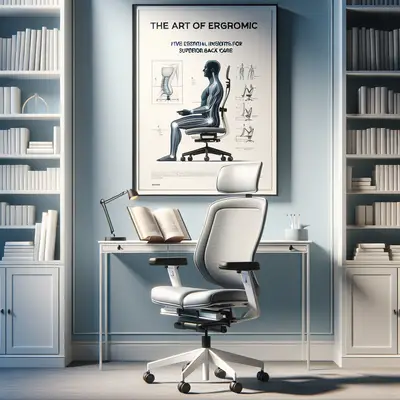
Many posture cues are vague: “Sit up straight” or “Don’t slouch.” A spine already sensitized by pain deserves more precision. The core ergonomic concept is neutral alignment: stacking joints in a way that allows the spine’s natural curves to be supported, not flattened or exaggerated.
From an ergonomic perspective, neutral sitting means:
- Your ears line up roughly over your shoulders, not in front of them
- Your shoulders rest over your hips without collapsing backward or rounding forward
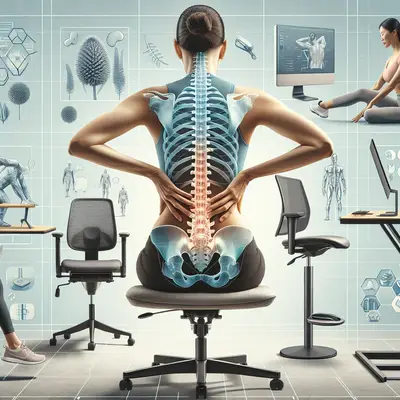
- Your lumbar curve (lower back) is supported, not forced flat against the chair
- Your hips and knees sit at approximately 90 degrees, or slightly more open if that feels kinder to your back
- Your feet rest fully on the floor or a footrest, not hovering or tucked behind you
For people with back pain, “neutral” is not about aesthetic posture; it’s about mechanical efficiency. This position distributes load through the spine’s natural curves rather than concentrating stress at a single segment. Over time, consistently finding this neutral default—even if only in small intervals—helps create a safer baseline from which you move, twist, and reach.
A practical refinement: treat neutral posture as a place you return to, not where you must stay rigidly. Gentle movement around this neutral—shifting weight, micro-adjusting the pelvis, relaxing then re-engaging support—is healthier than a static, perfectly vertical pose you cannot sustain.
Insight 2: Micro-Movements as Hidden Luxury for a Sensitive Back
For a sore or surgically repaired back, the true luxury is not a chair that holds you motionless. It is a setup that invites effortless, frequent movement. Static loading—holding one position too long—is a quiet enemy of spinal comfort, even when the posture is ideal on paper.
This is where micro-movements become powerful. Instead of scheduling a single stretch break every few hours, think: What is the smallest, most frequent movement my spine can enjoy without interrupting my work or conversations?
Examples of refined micro-movements include:
- Slightly tilting the pelvis forward and back while seated
- Gently shifting weight from one sit bone to the other
- Rolling shoulders back and down during an email or call
- Alternating one foot on a low footrest when standing
- Leaning subtly back into the chair’s recline mechanism, then returning to upright
A well-chosen chair with responsive recline, a height-adjustable desk, or a sit-stand workstation enables these subtle adjustments without drama. For a back that already complains easily, these small movements are not trivial—they maintain blood flow, nourish spinal discs, and reduce the cumulative strain that often triggers pain flares.
The sophisticated mindset shift: instead of chasing the “perfect” static setup, curate a workspace that supports elegant, ongoing motion.
Insight 3: The Visual Horizon—How Screens Quietly Shape Your Spine
For many people with back issues, the most underestimated ergonomic factor is not the chair; it is the screen. Where your eyes go, your head and neck follow—and where your head goes, your entire spine responds.
If your monitor or laptop is even a few inches too low, your head drifts forward, adding strain to the neck and upper back and subtly altering how forces travel down the spine. Over hours and months, this contributes to muscular fatigue and joint irritation.
A refined approach to screen ergonomics includes:
- Aligning the top of your main screen at or slightly below eye level, so your gaze falls naturally about one-third down the screen
- Positioning the monitor directly in front of you, not off to the side, to avoid sustained rotation through the neck and thoracic spine
- Keeping the screen at about an arm’s length away (or adjusted based on your vision) to prevent leaning forward
- Using an external keyboard and mouse when working on a laptop, so the screen can be raised without compromising arm and wrist position
For a spine that is already vulnerable, this visual discipline is powerful. You are, in effect, designing a horizon line that allows your head to remain balanced over your torso. Each time your gaze drops to a low screen or tablet, consider supporting the device—on a stand, books, or a dedicated riser—so you bring the technology to your posture, rather than sacrificing your spine to the screen.
Insight 4: The Ground Beneath You—Feet, Stability, and Back Comfort
Back pain sufferers often focus on the lumbar region and forget the role of the feet. Yet from an ergonomic standpoint, your feet are your foundation. When they lack support, your pelvis and spine must work harder to stabilize you.
A sophisticated detail often missed: true ergonomic seating is incomplete if your feet do not rest flat and stable.
Key refinements include:
- Ensuring your chair height allows your feet to rest fully on the floor; if not, using a footrest or stable box
- Avoiding perching on the edge of the chair with toes only touching the ground, which increases load on the lower back
- Being mindful of very high stools or bar-height seating for long durations, as dangling feet pull the pelvis into an unstable, often painful position
- Considering the interaction between footwear and flooring—high heels, for example, tilt the pelvis and can increase lumbar strain over time
For people with back issues, a thoughtfully selected footrest can be surprisingly transformative. It quietly anchors the lower body, encourages a more neutral pelvic tilt, and reduces the compulsion to cross legs or tuck feet under the chair—habits that may twist the spine and aggravate asymmetrical pain patterns.
Viewed this way, back comfort begins not just at the lumbar cushion, but at the ground.
Insight 5: The Transition Ritual—Protecting Your Back Between Positions
Most ergonomic advice focuses on where you sit or stand, not how you move between those positions. Yet for a sensitized back, transitions—standing up, bending to plug in a charger, reaching for a file—are often when pain spikes.
A refined ergonomics practice includes transition rituals: small, intentional sequences that protect the spine during movement.
Consider these habits:
- When rising from a chair, bring your feet under you, hinge slightly at the hips while keeping the back long, and use your legs—not a sudden spinal curl—to stand
- When picking up items from the floor, use a hip hinge or partial squat, keeping the object close to your body, rather than rounding through the lower back
- When rotating to reach for items, turn your whole body (hips and shoulders together) instead of twisting from the waist while the pelvis remains fixed
- Before a long walk after extended sitting, gently mobilize: a few controlled pelvic rocks, shoulder rolls, or a slow stand-and-stretch to “wake up” your spine
For chronic back issues, these rituals are not fussy details; they are guardrails. Over days and months, they help prevent those sharp, unexpected “twinges” that can derail progress and trigger flare-ups. Ergonomics, at this level, becomes a choreography of safer choices woven through your day, not a static arrangement of furniture.
Conclusion
Ergonomics, when approached with discernment, is less about gadgets and more about coherence. It is the art of aligning your environment with the needs of a spine that has already endured discomfort—and deserves better. By treating your setup as an ecosystem, refining neutral alignment, inviting subtle movement, curating your visual horizon, stabilizing your foundation, and protecting transitions, you transform ordinary spaces into quietly therapeutic ones.
For people living with back issues, these are not extravagant upgrades; they are expressions of respect for the body that carries you through every task, conversation, and ambition. Thoughtful ergonomics is, ultimately, a form of understated luxury: the luxury of moving through your day with less pain and more composure.
Sources
- [National Institute of Neurological Disorders and Stroke – Low Back Pain Fact Sheet](https://www.ninds.nih.gov/health-information/disorders/low-back-pain) - Overview of low back pain, common causes, and evidence-based management principles
- [Occupational Safety and Health Administration (OSHA) – Computer Workstations eTool](https://www.osha.gov/etools/computer-workstations) - Detailed guidance on ergonomic computer workstation setup, including monitor, chair, and keyboard positioning
- [Mayo Clinic – Office Ergonomics: Your How-To Guide](https://www.mayoclinic.org/healthy-lifestyle/adult-health/in-depth/office-ergonomics/art-20046169) - Practical, research-informed advice on aligning desks, chairs, and screens to reduce musculoskeletal strain
- [Harvard Health Publishing – The right way to stand and sit](https://www.health.harvard.edu/pain/the-right-way-to-stand-and-sit) - Evidence-based explanation of neutral posture and its impact on spine health
- [Cleveland Clinic – Proper Lifting Techniques](https://health.clevelandclinic.org/proper-lifting-techniques) - Guidance on safe movement and lifting strategies that protect the back during everyday transitions
Key Takeaway
The most important thing to remember from this article is that this information can change how you think about Ergonomics.