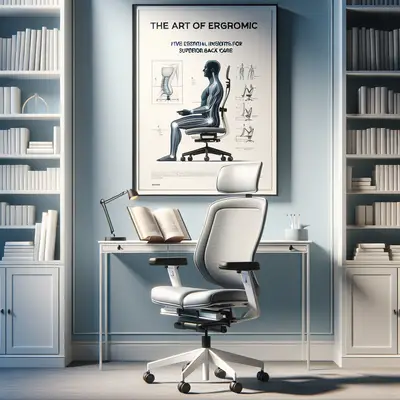
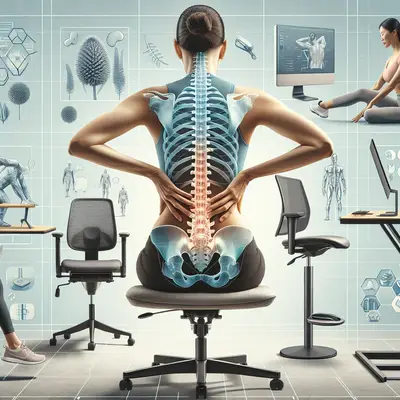
Back discomfort rarely announces itself with fanfare. It arrives quietly—an ache at 3 p.m., a stiffness when you stand, a subtle fatigue that makes every task feel heavier. True ergonomic refinement is not about a single “perfect” chair or the latest gadget; it is about orchestrating your environment, your posture, and your habits so that your spine is consistently, almost invisibly, supported.
This is ergonomics as quiet mastery: small, deliberate choices that transform how your back experiences the workday. Below are five exclusive, under-discussed insights that those living with back issues often discover the hard way—so you don’t have to.
Beyond Chair Height: The Subtle Power of Visual Ergonomics
Most ergonomic advice begins with your chair. A refined approach begins with your eyes.
When your monitor is too low, your neck flexes forward; when it is too high, your shoulders tense and your lower back compensates. Either way, your spine loses. Visual ergonomics—how your screen, documents, and lighting are arranged—can be as influential as lumbar support.
A sophisticated setup places the top of your primary screen at or just below eye level, at roughly an arm’s length distance. Dual monitors should be used asymmetrically: if you rely on one screen more than 70% of the time, it should sit directly in front of you, not slightly off to the side, to avoid subtle, repeated rotation of the neck and upper back.
Lighting matters as much as angles. Overly bright, overhead light encourages you to lean forward to reduce screen glare, compressing your spine. A more considered arrangement uses indirect lighting, a high-quality desk lamp positioned opposite your dominant hand, and a matte monitor finish or anti-glare filter. This allows you to sit back into the chair, maintaining the natural curves of your spine while your vision remains relaxed and unstrained.
For those with existing back issues, this visual precision can mean the difference between a tolerable workday and one that ends in pain—long before any orthopaedic chair earns its keep.
Micro-Adjustments: Treating Your Workstation Like a Tailored Suit
Too many people treat ergonomic equipment like off-the-rack clothing—“good enough” instead of meticulously tailored. Yet your workstation should fit you as precisely as a custom suit.
This means rethinking “set it and forget it.” The truly refined approach is to treat adjustment as an ongoing dialogue between your body and your environment. A few millimeters can change how your back feels at the end of the day.
Pay close attention to three quiet indicators:
- Unconscious fidgeting or leg crossing often signals your seat height is slightly wrong or your feet are not fully supported. Your hips should be level with or just slightly above your knees, with your feet resting firmly and evenly on the floor or a stable footrest.
- Subtle shoulder elevation suggests your armrests are too high, causing tension that radiates down your spine. Armrests should allow your shoulders to relax, with elbows bent at roughly 90 degrees and wrists floating neutrally above the keyboard.
- Gradual sliding forward on the seat indicates insufficient backrest depth or support. Your lower back should feel gently, continuously cradled, not intermittently “caught” when you remember to sit back.
Revisit these variables weekly rather than only when pain flares. Consider seasonality too: different footwear, clothing layers, or even a new carpet can alter effective seat height and foot support. In a premium ergonomic environment, “adjustment” is not a one-time event; it is a quiet ritual of refinement.
The Hidden Culprit: Static Bracing and “Quiet” Tension
Many people with back pain invest in excellent chairs yet overlook one of the most insidious stressors on the spine: static bracing. This is the subtle, continuous muscle tension you hold without realizing it—shoulders slightly lifted, abdomen clenched, jaw tight, toes gripping the floor.
Static bracing feels like “good posture” to many people, especially those who have been told to “sit up straight” their entire lives. In reality, it locks your spine into a rigid configuration and prevents the micro-movements that nourish discs, joints, and supporting muscles.
A more sophisticated approach to ergonomics encourages relaxed alignment instead of rigid uprightness. Your spine is designed for gentle motion, not immobilization. You might think of it as poised ease rather than perfect form.
To identify static bracing, perform brief, discreet “release audits” throughout the day:
- Drop your shoulders down and slightly back; notice if they were higher than you realized.
- Unclench your jaw and let your tongue rest gently on the floor of your mouth.
- Soften your abdomen for a few breaths instead of “holding in” your core.
- Let your pelvis roll subtly forward and back until you find a neutral, unforced position.
You are not abandoning support—you are abandoning excess effort. For a back already sensitized by prior injuries or episodes of pain, this shift away from chronic low-level bracing can be quietly transformative.
Movement as Design, Not Afterthought
“Take breaks” is familiar advice; “design movement into your workday” is a different philosophy altogether. Those with back issues often discover that it is not just whether they move, but how intentionally that movement is embedded into their environment.
Consider ergonomics not as static positioning, but as choreography. Your day should alternate between sitting, standing, and brief, deliberate walking or stretching periods, each one arranged to be as frictionless as possible.
Thoughtful strategies include:
- Dual-position workstations: If a full sit–stand desk is not feasible, use a high counter or secondary surface where you can do lighter tasks (emails, calls) standing for 10–20 minutes at a time.
- Task pairing with movement: Stand or walk slowly during phone calls, or between video meetings. Place the printer, frequently used files, or water station just far enough away that you must stand and walk periodically, but not so far that it feels like a chore.
- Micro-mobility instead of “hero stretches”: Instead of a single, intense stretching session once a day, build in 30–60 seconds of simple, spine-friendly movements every hour—gentle pelvic tilts while seated, ankle pumps, shoulder rolls, or standing back extensions.
For people living with back discomfort, this architecture of movement is often more sustainable than relying on willpower alone. The environment quietly nudges you toward what your spine needs: variety, circulation, and intermittent relief from static load.
Cushioning, Textures, and Temperature: The Sensory Side of Ergonomics
Luxurious ergonomics is not only about angles and alignments; it also honors the sensory experience of your back. Subtle aspects like materials, textures, and temperature can diminish (or aggravate) pain more than most people realize.
Overly soft seating, for instance, may feel indulgent at first, but it often allows your pelvis to sink and rotate, stressing the lower spine. Conversely, very firm chairs can create pressure points that provoke fidgeting and fatigue. The refined middle ground is structured softness: a supportive base with just enough cushioning to distribute pressure without collapsing.
Texture matters too. Breathable fabrics that allow slight friction keep you from sliding forward, reducing the tendency to perch at the front of the seat and lose lumbar support. Slippery leather, while visually elegant, can sometimes encourage subtle, continuous muscular effort to maintain position—tiresome for an already sensitive back.
Temperature is an often-ignored dimension of ergonomic comfort. A cool environment may cause muscles to tighten defensively, while excessive warmth can lead to sluggishness and slumping. Those with chronic back issues often fare best with:
- A slightly warmer core and lower back (via a light layer or gentle heating pad used judiciously and intermittently).
- A cooler head and hands to maintain alertness and prevent overall lethargy.
In an elevated ergonomic setting, these sensory variables are curated intentionally, not left to chance. The goal is a working environment that feels quietly supportive, never distracting—where your back is neither negotiating pressure points nor fighting the room’s climate.
Conclusion
Exquisite ergonomics is not defined by a single expensive chair or a dramatic piece of technology. It is the accumulation of subtle, intelligent decisions: how your eyes meet the screen, how your body dialogues with the chair, how tension is released instead of stored, how movement is architected into the day, and how materials and temperature gently collaborate with your spine.
For those living with back issues, these details are not luxuries; they are the difference between merely enduring the workday and completing it with clarity, comfort, and reserve energy. The most refined ergonomic environment is the one that becomes almost invisible—because your back, finally, has nothing urgent left to say.
Sources
- Mayo Clinic – Office ergonomics: Your how-to guide - Practical guidance on workstation setup, including chair, desk, and monitor positioning
- Occupational Safety and Health Administration (OSHA) – Computer Workstations eTool - Detailed, evidence-based recommendations for ergonomic computer workstation design
- Harvard Health Publishing – The importance of moving throughout the day - Explains why breaking up sitting time with movement is crucial for musculoskeletal and overall health
- Cleveland Clinic – How to Improve Your Posture at Work - Discusses posture, alignment, and strategies to reduce discomfort during desk work
- National Institute for Occupational Safety and Health (NIOSH) – Musculoskeletal Health Program - Provides research and resources on preventing work-related musculoskeletal disorders, including back issues
Key Takeaway
The most important thing to remember from this article is that this information can change how you think about Ergonomics.