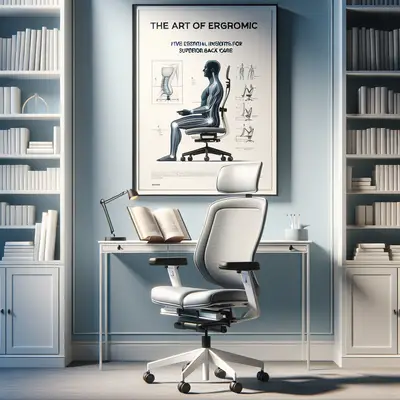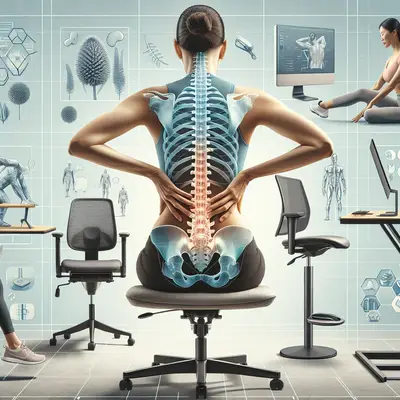
In a world that rarely pauses, your back carries the weight of every deadline, every commute, every conversation. Ergonomics is often framed as a set of rules or corrections, but for those who live with back sensitivity, it is closer to an art form: the quiet orchestration of posture, environment, and intention. This is not about obsessing over perfect alignment every second of the day; it is about designing small, exquisite moments of ease that accumulate into long-term spinal resilience.
Below, you’ll find five exclusive, refined insights that move beyond generic tips—subtle upgrades that people living with back issues can feel, not just read about.
Reframing Ergonomics: From Posture Policing to Comfort Design
Conventional advice often reduces ergonomics to “sit up straight” and “keep your screen at eye level.” While technically correct, this oversimplification ignores the lived reality of pain: stiffness, fatigue, and the way discomfort quietly reshapes behavior across the day.
A more elevated approach treats ergonomics as comfort design—curating spaces that respond to your body rather than forcing your body to submit to the space. This means thinking in layers: surface (chair, mattress, floor), orientation (screen height, arm support), and timing (how long you remain in one position). Instead of striving for a rigid “perfect posture,” aim for a range of supportive postures that your back can move through with minimal strain.
For individuals with chronic or recurring back pain, this mindset shift is powerful. You move away from guilt (“I sat wrong”) to strategy (“How can I adjust my environment so my back has less work to do?”). This becomes the foundation on which more refined practices can rest.
Insight 1: Micro-Adjustments Beat Perfect Posture
Perfection is tiring; precision, when overdone, becomes another form of tension. Your spine is built to move, and insisting on one immaculate posture all day will fatigue your muscles and provoke discomfort, even if that posture is technically “correct.”
Instead, introduce micro-adjustments every 15–30 minutes. These are nearly invisible to others but highly noticeable to your back:
- Slightly tilt your pelvis forward or backward.
- Shift weight from one sitting bone to the other.
- Rotate your shoulders subtly, then let them settle lower.
- Alter the angle of your feet—wider, narrower, one slightly forward.
Think of these as “postural sips of water” for a dehydrated spine. If you are working at a desk, consider micro-signals that prompt variation: a recurring calendar reminder, a smart watch vibration, or pairing adjustments with routine actions (each email you send, every phone call you end).
For those with disc issues, spinal stenosis, or longstanding muscular tension, this gentle variability distributes mechanical stress more evenly across tissues. Rather than searching for one posture that doesn’t hurt, you cultivate a repertoire of postures that share the load.
Insight 2: The Desk Is Only Half the Story—Ergonomics of Transition
Much ergonomic advice stops at the workstation. But your back experiences your day as a continuum, not as isolated moments: from the way you slide into the car to how you descend into a sofa at night. The transitions between positions often cause more irritation than the positions themselves.
Consider refining the following “micro-moments”:
- Sitting down and standing up:
Instead of collapsing into a chair, hinge lightly at the hips, keep your chest gently open, and use your legs to control the descent. When rising, bring your nose slightly over your toes and press through your feet rather than pulling from your lower back.
- Getting in and out of the car:
Sit first with both legs outside the car, then pivot both legs in together as a unit, rather than twisting through the lumbar spine. Reverse this sequence when exiting.
- Lying down and getting out of bed:
Use the log-roll technique: roll to your side, let your feet slide off the edge of the bed, then push up with your arms while your legs act as a counterweight. It is a small refinement that spares your spine an abrupt flexion under load.
These transitions are where hurried, careless movements often irritate already-sensitive tissues. By treating them as key ergonomic moments—not afterthoughts—you offer your back consistent respect throughout the day, not just when seated at a desk.
Insight 3: Layered Support Instead of One “Miracle” Chair
The market promises salvation in a single, heroic product: the perfect chair, the perfect cushion, the perfect mattress. While high-quality equipment certainly helps, the most refined ergonomic setups use layers of support that adapt to different needs across the day.
Consider a layered approach:
- Primary foundation:
A supportive chair with adjustable height, backrest, and armrests—or a well-structured task chair if you work from home. Think of this as your “anchor.”
- Secondary enhancers:
A small lumbar roll or adjustable pillow that can be repositioned as your back tires; a footrest or even a stable box to change leg height; a thin folded towel to fine-tune seat depth.
- Situational tools:
A standing mat for periods at a standing desk; a laptop riser and external keyboard for travel or café work; a portable lumbar support for car or airplane seats.
This layered strategy recognizes that no single configuration suits your spine for an entire day, especially if you already live with pain. By allowing your environment to adapt in multiple small ways, you reduce the pressure on your body to be endlessly resilient. You and your back are no longer at the mercy of a single surface.
Insight 4: “Ergonomic Breathing” to Quiet Back Tension
Ergonomics usually addresses muscles and joints, but breathing is an overlooked mechanical force acting on your spine. Shallow, upper-chest breathing often accompanies stress and sitting marathons, subtly tightening the neck, upper back, and lumbar stabilizers.
A refined practice is to introduce ergonomic breathing breaks—brief intervals where you align your posture to permit full, comfortable breaths:
- Sit or stand with your ribs gently stacked over your pelvis (no dramatic arching).
- Let your shoulders become heavy rather than pulled back aggressively.
- Inhale through the nose, allowing the lower ribs and upper abdomen to expand softly, as if they are widening in all directions.
- Exhale slowly through the mouth, as though gently fogging a window, and feel your ribcage settle.
Even 4–6 breaths in this manner can reduce muscular guarding around the spine. When practiced at your workstation, in the car, or before sleep, it complements physical support with nervous system support—particularly meaningful if your pain tends to flare under stress.
Over time, you may notice that your back “releases” more readily when breathing is addressed, making ergonomic adjustments more effective and comfortable.
Insight 5: Curating an Evening Environment That Resets the Day’s Strain
Modern ergonomics tends to focus on working hours, yet the hours after work quietly dictate how well your back recovers. Evenings offer a chance to either reinforce the day’s strain (slouching into a deep sofa, craning forward over a phone) or gently unwind it.
Consider refining your evening environment:
- Sofa strategy:
If your sofa is deep and soft, add a firm cushion behind your lower back and another under your thighs to reduce sagging. Sit slightly diagonally with one leg straightened occasionally to vary hip angles.
- Device positioning:
Elevate phones or tablets closer to eye level using a pillow, stand, or armrest rather than bending your neck forward. This minimizes cumulative strain on the cervical and upper thoracic spine.
- Evening micro-ritual:
Create a five-minute “back reset” before bed: gentle pelvic tilts lying on your back, knees bent; light knee-to-chest movements within a comfortable range; or simply lying in a supported position (a pillow under knees) to decompress the lumbar area.
- Mattress and pillow audit:
A medium-firm mattress generally supports spinal alignment well for many people, and pillow height should allow the neck to continue the natural line of the spine, not kink above or below it. If your back consistently feels worse upon waking, this is an ergonomic environment worthy of careful review.
Approaching evenings as a daily reset rather than a passive collapse into comfort offers your back a genuine chance to repair, especially if pain has been smoldering beneath the surface for months or years.
Conclusion
Elegant ergonomics is less about rigid rules and more about quiet precision—dozens of subtle, almost invisible decisions that collectively transform how your back experiences the day. For those living with back issues, this approach provides something rare: a sense of agency wrapped in comfort.
Micro-adjustments replace the tyranny of perfect posture. Transitions become deliberate rather than careless. Support is layered, not left to a single object. Breathing participates in your spine’s relief, and your evenings are curated to undo the day’s demands rather than amplify them.
Ergonomics, at its most refined, is not an aesthetic of straight lines—it is a lived experience of reduced strain, enhanced ease, and a back that feels quietly, reliably supported.
Sources
- National Institute of Neurological Disorders and Stroke – Low Back Pain Fact Sheet – Overview of causes, risk factors, and management strategies for low back pain.
- Mayo Clinic – Office Ergonomics: Your How-To Guide – Practical guidance on optimal workstation setup and posture.
- Harvard Health Publishing – Is Your Work Chair Causing Back Pain? – Discussion of seating, spinal support, and evidence-based ergonomic adjustments.
- Cleveland Clinic – Proper Lifting Techniques and Back Care – Details on movement and transition strategies that protect the spine.
- CDC Workplace Health Resource Center – Ergonomic Guidelines – Evidence-based recommendations for ergonomic practices to reduce musculoskeletal strain.
Key Takeaway
The most important thing to remember from this article is that this information can change how you think about Ergonomics.