The most discerning backs do not simply “cope” with modern life; they are curated. In a world of relentless screens, hurried meals, and improvised workspaces, ergonomics becomes less about office furniture and more about the quiet architecture of how you inhabit your day. Thoughtful design, microscopic adjustments, and intelligent constraints can transform an ordinary environment into a refuge for a demanding spine. This is not about perfection—it is about precision.
Below are five exclusive, often-overlooked ergonomic insights for those who refuse to let back pain dictate the terms of their life.
Insight 1: Design Your Posture in Motion, Not in Stillness
Most ergonomic advice freezes posture into a single, idealized position. Yet the spine is engineered for elegant movement, not rigid display.
Instead of chasing a “perfect” pose, design your environment to encourage subtle, continuous motion:
- Use your chair as a range, not a destination. Alternate between sitting back with full support and a gently more upright, active sit where your back lightly grazes the backrest.
- Introduce micro-rituals of movement: a 20-second spinal decompression every time you hit “send,” a gentle neck glide after each call, a shoulder roll sequence every time you stand.
- Adjust monitor height so your eyes track in a shallow vertical band, discouraging the fixed, downward stare that compresses the neck and upper back.
- Favor input devices (keyboard, mouse, trackpad) that allow your elbows to stay near your sides, so movement comes from the shoulder girdle and upper back rather than only the wrist and neck.
Well-designed ergonomics treats posture as choreography: small, graceful, frequent movements that keep the spine nourished and engaged, rather than ceremoniously arranged and gradually inflamed.
Insight 2: Set “Elegant Limits” Instead of Relying on Willpower
People with back issues often know what to do—stand more, sit less, take breaks—but rely on sheer willpower to follow through. Premium ergonomics replaces effort with architecture.
Consider embedding refined constraints into your environment:
- Timed seating windows: Instead of an open-ended sit, decide that email, not entire mornings, is done seated. Calls might be standing; strategy work could be done in a reclined, supported posture.
- Layered work zones: A high counter for standing tasks, a deeply supportive chair for long writing sessions, and a low, lounge-style space for reading or reviewing. Your spine receives variation by design, not by accident.
- Soft friction, not hard rules: Place your standing setup somewhere slightly less convenient than your primary desk—easy enough to use, but just different enough to nudge you into changing position during the day.
- Subtle prompts: Use a watch or phone reminder not as an alarm, but as a cue to change shape—stand, lean, recline, or walk for one minute.
By replacing self-discipline with well-placed limits, you create a lifestyle where the path of least resistance is also the path of least strain.
Insight 3: Treat Your Chair as an Instrument, Not a Throne
For many, a chair is something you “have.” For a back-conscious person, a chair is something you tune.
Consider a more meticulous approach:
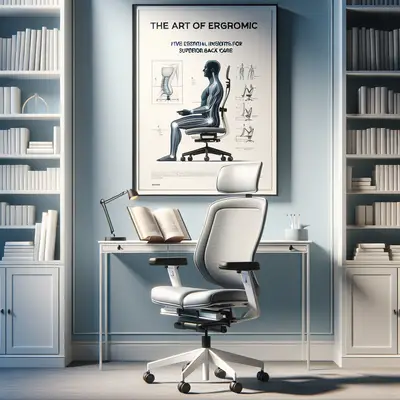
- Seat height: Your knees should be roughly level with or slightly below your hips, so your pelvis can tilt forward just enough to maintain a gentle lumbar curve. Oversized chairs that leave your feet dangling are a quiet assault on the lower back.
- Seat depth: If the seat pan is too long, you are forced to slouch or perch. Aim to leave a two- to three-finger gap between the edge of the seat and the back of your knees so your back can actually contact the backrest.
- Backrest angle: Many demand a strictly upright chair; the spine often prefers a slight recline—around 100–110 degrees—reducing disc pressure while still allowing full engagement with your work.
- Armrests as precision supports: They should meet your elbows, not dictate their position. If armrests push your shoulders upward or outward, they are training tension, not offering support.
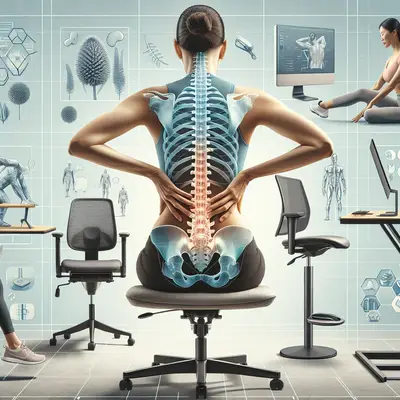
- Lumbar support as a “guide,” not a wedge: The goal is to suggest a healthy curve, not to force it. Overly aggressive lumbar bumps can create as much strain as too little support.
Fine-tuning a chair has less to do with price and more to do with fit. A thoughtfully adjusted mid-range chair, paired with an attentive user, will often outperform a luxurious but poorly configured one.
Insight 4: Expand Ergonomics Beyond the Desk
Your spine does not belong to your workstation. It belongs to your life.
People with refined back care practices audit their entire day, not just their office:
- The commute: Adjust car seat recline slightly back, bring the seat closer so you are not reaching for the pedals, and use a small lumbar roll if the built-in support is poorly placed.
- The sofa trap: Deep, slouch-inducing couches are notorious for quiet back sabotage. If you enjoy them, add structure—a small pillow at the low back, feet on a low ottoman to open the hip angle, and periodic position changes.
- Kitchen and vanity counters: If you constantly lean forward while chopping or washing, raise the work surface slightly with a stable cutting board block or bring tasks closer to your body.
- Sleep as the ultimate ergonomic reset: A medium-firm mattress that supports natural alignment and a pillow that keeps the neck neutral can undo or amplify the day’s loading. For side sleepers, consider a small pillow between the knees to preserve hip and lumbar alignment.
- Leisure screens: Tablets and phones in the lap drive the head forward. Elevate them with a stand or pillow so your neck remains gracefully stacked over your ribs.
Truly elevated ergonomics recognizes that your back does not care where it’s strained—only that it is. A sophisticated approach smooths every rough edge in the 24-hour cycle, not just the eight-hour workday.
Insight 5: Curate Micro-Comforts Instead of One Grand Solution
The temptation is to seek a single transformative purchase or posture—one chair, one desk, one device that solves everything. In reality, the spine often responds best to a collection of subtle, layered comforts.
Consider building a personal “comfort portfolio”:
- A slim, portable lumbar roll you use across settings: office chair, airplane seat, dining chair.
- A lightly cushioned anti-fatigue mat where you stand the most—kitchen, standing desk, or workshop.
- A footrest or low stool under the desk to give your legs alternative resting positions and relieve lower back demand.
- A lightweight laptop stand and separate keyboard so you can transform almost any surface into a more spine-respecting setup.
- A quiet, daily decompression ritual—such as lying flat on the floor with knees bent and feet supported, allowing the spine to settle and re-lengthen after cumulative load.
None of these elements is dramatic alone. Together, they create a refined ecosystem in which your back is consistently, almost effortlessly, protected.
Conclusion
Elegant ergonomics is not a piece of furniture; it is a philosophy. It recognizes that your spine is shaped not just by what you do, but by what your environment silently encourages. When you design motion instead of stillness, set intelligent limits, tune your chair, extend ergonomics beyond the desk, and curate micro-comforts, you move from damage control to deliberate stewardship.
For those living with back issues, this shift—from surviving to designing—can be the difference between a spine that is constantly negotiating with pain and one that is quietly, reliably supported by every detail of your day.
Sources
- [National Institute of Neurological Disorders and Stroke – Low Back Pain Fact Sheet](https://www.ninds.nih.gov/health-information/disorders/low-back-pain) - Overview of causes, mechanics, and management of low back pain
- [Mayo Clinic – Office Ergonomics: Your How-To Guide](https://www.mayoclinic.org/healthy-lifestyle/adult-health/in-depth/office-ergonomics/art-20046169) - Practical guidance on workstation setup and posture principles
- [Occupational Safety and Health Administration (OSHA) – Computer Workstations eTool](https://www.osha.gov/etools/computer-workstations) - Detailed recommendations for ergonomic design and adjustments
- [Harvard Health Publishing – How to Sit to Protect Your Back](https://www.health.harvard.edu/pain/how-to-sit-to-protect-your-back) - Evidence-informed advice on sitting mechanics and back protection
- [Cleveland Clinic – Back Pain and Ergonomics](https://health.clevelandclinic.org/ergonomics-and-back-pain) - Clinical perspective on how ergonomic strategies help manage and prevent back pain
Key Takeaway
The most important thing to remember from this article is that this information can change how you think about Ergonomics.