Back pain rarely arrives as a dramatic event. More often, it is the quiet sum of thousands of small compromises: a chair that almost fits, a desk that is nearly the right height, a posture that is good enough—until it isn’t. Ergonomics, when approached thoughtfully, is not about buying an expensive chair and hoping for the best. It is about curating an environment and a set of habits that continually signal to your spine: you are being taken seriously.
Below are five exclusive, refined perspectives on ergonomics—less about quick fixes and more about the deliberate architecture of a spine-first life.
Insight 1: Think in Postural “Intervals,” Not Perfect Stillness
For many people with back issues, “good posture” has been framed as a single, rigid position to be held all day. That framing is quietly harmful. A static “ideal” posture, no matter how aligned, becomes stressful when prolonged. The nervous system and spinal tissues thrive on variation, not stillness.
Ergonomics works best when you think in intervals rather than absolutes. Consider a simple cadence: 20–30 minutes in a supported, upright position; 30–60 seconds to stand, shift, or walk; then back to work. This interval-based approach respects the spine’s need for movement while still honoring your focus. Instead of chasing a flawless sitting pose, design your environment so that small position changes are effortless: an adjustable chair, a footrest that invites leg repositioning, a desk setup that allows you to sit slightly reclined for a period and then more upright for another.
This shift—from “hold perfect posture” to “curate intelligent intervals”—reduces the pressure to perform posture and replaces it with a more realistic, sustainable rhythm. Over time, these small transitions accumulate into less stiffness, less fatigue, and a spine that feels actively managed rather than merely tolerated.
Insight 2: Calibrate Your Chair as If It Were Tailored Clothing
Most people sit in office chairs as they arrive: factory settings, generic assumptions. Yet a high-quality chair is more like a suit jacket—it only becomes exceptional when it is tailored. For those with back issues, fine-tuning your chair is not a luxury; it is a form of daily therapy.
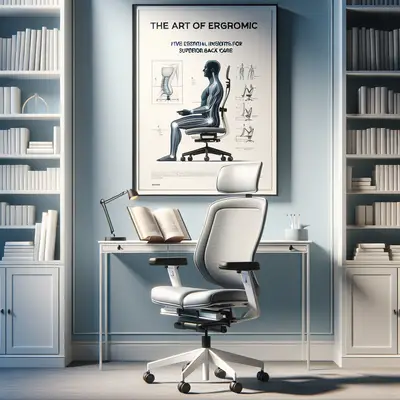
Begin with seat height: your feet should rest fully on the floor (or a footrest) with your knees roughly at hip height or slightly below, allowing the pelvis to tilt gently forward rather than collapsing backward. Adjust seat depth so that there is a small gap—about two to three fingers—between the back of your knees and the seat edge, avoiding pressure that can affect circulation. Next, refine lumbar support: it should meet the natural curve of your lower back, not push aggressively into it. If the built-in support misses your curve, a slim, high-quality lumbar cushion can be more effective than an oversized pillow.
Finally, consider the backrest angle and tension. A slight recline—100 to 110 degrees rather than a rigid 90—can reduce disc pressure in the lumbar spine. The key is controlled recline, where your torso is gently cradled rather than slumping. When you treat chair calibration with the attention you might give to bespoke clothing, your seating stops being a compromise and starts functioning as a tailored support system for your spine.
Insight 3: Align the Screen to Protect the Neck—and Quiet the Upper Back
Many people with lower back complaints are surprised to discover how much their neck and upper back positioning influence their symptoms. A forward-jutting head, a slightly rotated neck, or a subtly twisted torso while looking at multiple screens can send tension spiraling down the spine. An elegant back-care setup respects the entire spinal column as a single, interconnected structure.
At a minimum, your primary screen should be positioned so that the top third of the display is at, or just below, eye level when you sit tall, and the screen is about an arm’s length away. If you use a laptop extensively, a separate keyboard and mouse paired with a laptop stand is not an indulgence—it is a baseline requirement to avoid sustained neck flexion. For multi-monitor users, choose a true “primary” screen and place it directly in front of you. Secondary screens should be positioned close enough to minimize neck rotation; if you routinely work across two screens, consider aligning them symmetrically so your gaze alternates, rather than constantly turning to one side.
These subtle alignments matter. When the neck is consistently neutral, the muscles of the mid and lower back are less likely to overcompensate. The result is not merely comfort in the moment, but a gradual easing of the chronic tension that can fuel persistent back discomfort.
Insight 4: Treat Transitions as Micro-Events for Your Spine
Most ergonomic conversations focus on where you sit or stand, not how you move between positions. Yet many people with back issues notice that pain flares when rising from a chair, bending to pick something up, or shifting from desk to couch. These transitions are quiet stress tests for the spine, and they deserve specific design and attention.
Start with standing up and sitting down. Position your chair so that your feet can be planted firmly under or slightly behind your knees. When standing, lean your torso slightly forward from the hips, engage your legs, and allow your spine to stay relatively long rather than curling forward. When sitting, reverse the path: hinge at the hips, reach back for the chair with your hips rather than collapsing into it, and keep your core lightly engaged as you lower yourself. These are not dramatic movements; they are refined, deliberate choices that reduce sudden load on the lumbar region.
Apply the same principle to everyday motions—picking up a bag, reaching for a lower drawer, turning to speak with someone behind you. Design your workspace so that heavy items live between knee and chest height, rarely requiring deep bending or twisting. Place frequently used objects within a comfortable arm’s reach. Over time, these micro-events, upgraded with better mechanics and intelligent placement, can significantly reduce the little jolts and strains that accumulate into chronic back irritation.
Insight 5: Curate a Multi-Posture Workspace, Not a Single “Perfect” Setup
The most sophisticated ergonomic environment is not a throne; it is a landscape. A single, meticulously adjusted chair-and-desk arrangement is valuable, but its benefits are amplified when paired with alternative, thoughtfully designed positions throughout your day.
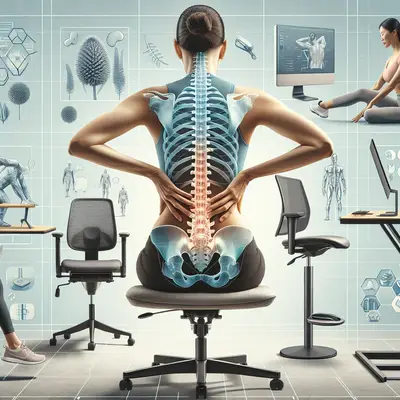
Consider three distinct “stations” within your environment. First, a primary, fully supported workstation: adjustable chair, well-positioned desk, and optimally placed screen. Second, a high-quality standing configuration or sit-stand desk setup, where your keyboard height allows elbows to rest at roughly 90 degrees and your weight is distributed through both feet, perhaps complemented by a small anti-fatigue mat or low footrest to invite subtle shifting. Third, a “softer” but structured space—such as a firm sofa or lounge chair with added lumbar support and a lap desk—reserved for lower-intensity tasks like reading or email triage.
Rotating intelligently between these stations—guided by task demands and body feedback—grants your spine a variety of loading patterns. This multi-posture approach respects the reality that no single position, however well-designed, can serve the body perfectly for eight to ten hours. Instead of hunting for one perfect ergonomic formula, you are composing a daily choreography of positions that keep your back engaged, supported, and subtly refreshed.
Conclusion
Ergonomics, at its most refined, is not a collection of gadgets but a philosophy: your spine is a central asset, and your environment should be curated accordingly. Thinking in postural intervals, tailoring your chair like custom clothing, aligning your visual field to protect your neck, honoring the mechanics of everyday transitions, and designing a multi-posture workspace elevate back care from basic comfort to an ongoing, intelligent ritual.
For those already living with back issues, these are not abstract principles—they are levers. Each adjustment, each small refinement, is an opportunity to replace strain with support, and resignation with deliberate care. Over weeks and months, this quiet, consistent attention can reshape not only how your back feels, but how you inhabit your day.
Sources
- [National Institute of Neurological Disorders and Stroke – Low Back Pain Fact Sheet](https://www.ninds.nih.gov/health-information/disorders/low-back-pain) – Overview of causes, risk factors, and management of low back pain
- [U.S. Department of Labor, Occupational Safety and Health Administration (OSHA) – Computer Workstations eTool](https://www.osha.gov/etools/computer-workstations) – Detailed guidance on optimal workstation setup and posture
- [Mayo Clinic – Office Ergonomics: Your How-To Guide](https://www.mayoclinic.org/healthy-lifestyle/adult-health/in-depth/office-ergonomics/art-20046169) – Practical recommendations for adjusting seating, desk, and monitor height
- [Harvard Health Publishing – 5 Tips for Better Posture](https://www.health.harvard.edu/staying-healthy/5-tips-for-better-posture) – Evidence-informed advice on posture and its impact on back and neck pain
- [Centers for Disease Control and Prevention (CDC) – Workplace Health in the Office](https://www.cdc.gov/workplacehealthpromotion/initiatives/resource-center/case-studies/office/index.html) – Information on creating healthier, more ergonomic office environments
Key Takeaway
The most important thing to remember from this article is that this information can change how you think about Ergonomics.